Multi-City & ChatGPT SEO (GEO)
Multi-City SEO & How to Rank in ChatGPT (GEO): Cost & Architecture of Regional Page Grids Without Google Penalties ($1,800–$4,500)
Why One Generic 5-Page Corporate Website Cannot Capture Nationwide or International Buyers in 2026
Modern search engines map explicit buyer geography: prospects in Kyiv, Lviv, Dnipro, Munich, or Austin search for a service plus their city, and Google surfaces pages proving local service terms, delivery logistics, and nearby completed projects. Consequently, a single generic brochure website misses 70–85% of regional search demand—yet mass-cloning 100 identical template pages swapping only the city token quickly triggers Google doorway penalties.
Meanwhile, buyer discovery has shifted toward AI answer engines like ChatGPT, Perplexity, and Google AI Overviews. Capturing both engines takes disciplined multi-city SEO and ChatGPT GEO optimization—starting with a 30-second diagnostic inside Site Roast.
Why Generic Services Pages Lose Local Search & Why Spam City Clones Kill Domains
Scalable multi-location SEO page grids balance genuine regional proof against strict spam-free engineering.
1. Showing Real Regional Supply Coverage Upfront (Polymer Case Proof)
When your company supplies materials or deploys crews nationwide, buyers need immediate proof of regional distribution on the very first screen. For Polymer, supplying industrial fabrics and polymer films nationwide since 2003, we positioned five distinct product directions alongside a regional presence map across Dnipro, Kyiv, Lviv, and Odesa right on the homepage:

2. How Engineered Programmatic SEO Differs from Doorway Spam
Rather than duplicate boilerplate pages, engineered local hubs carry distinct shipping/crew schedules, localized pricing notes, regional completed case studies, connected `LocalBusiness`/`Service` schema, and clean semantic URLs.
Cost & ROI of Multi-City Page Grids ($1,800–$4,500) vs Paid Ads Across 10 Cities
Running separate Google Ads campaigns across ten cities multiplies monthly overhead, whereas an owned programmatic grid compounds organically:
Buying Regional Google Ads Across 10 Cities vs Building an Owned Multi-City + GEO Grid
- Conversion: 1.0%
- Inbound Leads: 17 leads/mo
- Cost per Lead (CPL): $176 per lead
- Closed Deals: 3.4 deals/mo
- Gross Revenue: $4,590 margin vs $3,500/mo cost
- Conversion: 3.8%
- Inbound Leads: 48–65 organic leads/mo once indexed
- Cost per Lead (CPL): $14 blended Year 1 ($0/click afterward)
- Closed Deals: 11 deals/mo
- Gross Revenue: $14,850 monthly gross profit
Dedicated city landing pages also raise Google Ads Quality Scores if you choose to run targeted regional campaigns while SEO matures.
1. Comparison of Regional Scaling Approaches
| Criterion | Single Generic Page | Spam City Clones | Engineered Next.js Grid + GEO |
|---|---|---|---|
| Multi-City Indexation | Ranks in 1 home city max | Hit by Google Doorway filters | 10–60+ unique indexed hubs |
| Mobile Speed (4G) | 3–5s typical builders | 4s+ heavy theme bloat | < 0.8s (PageSpeed 95–100) |
| Location Capture | Generic phone box | Zero logistics routing | City selection built into calculator |
| ChatGPT / AI Citations | Missing structured context | Ignored as thin spam | `llms.txt` + connected Schema.org |
2. Capturing Exact Build Location Inside Interactive Lead Funnels
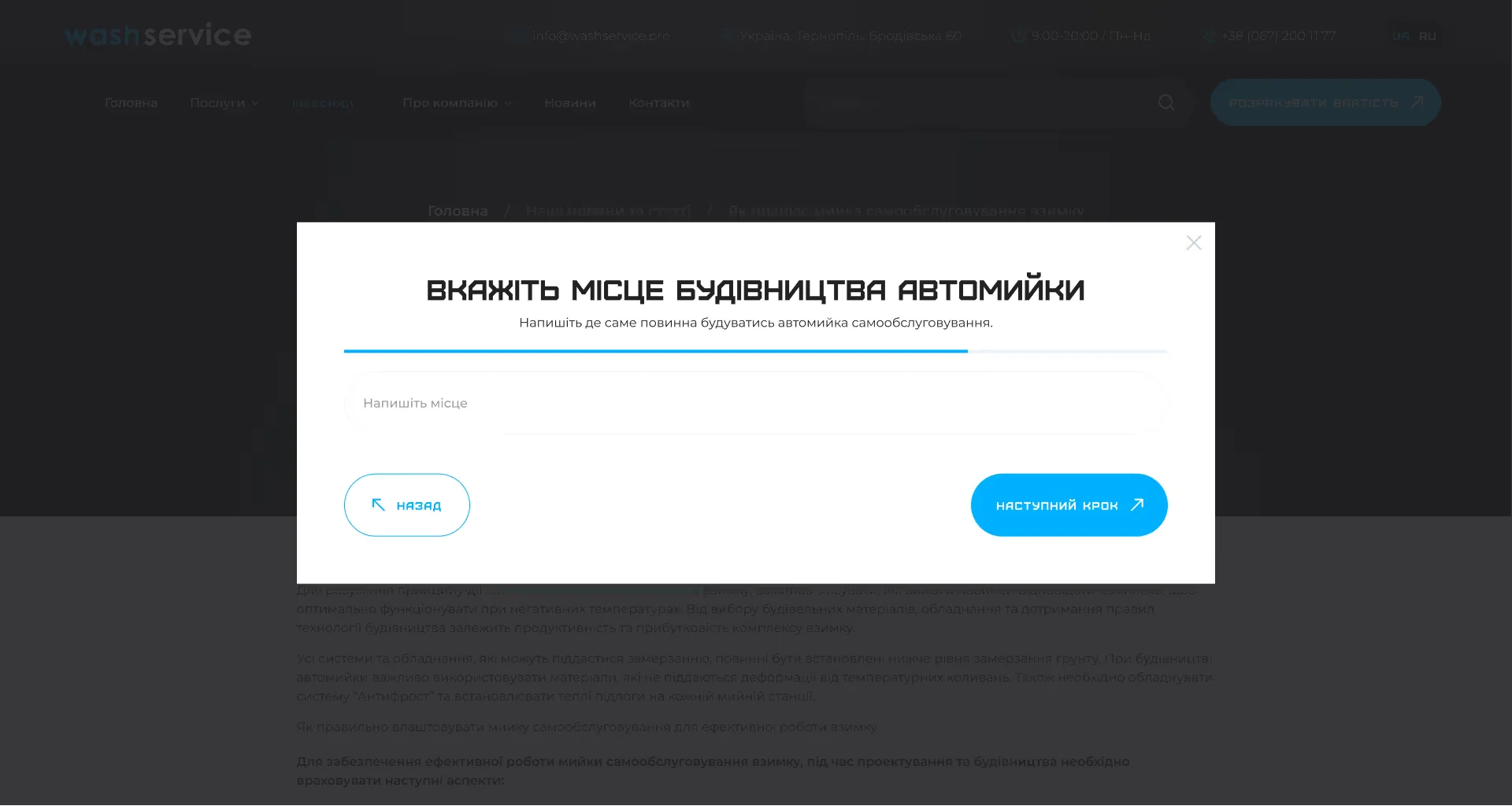
In our interactive calculator for WashService, step 3 explicitly asks investors to specify the construction city so estimators match local soil, logistics, and regional crew availability immediately:
How to Rank in ChatGPT, Perplexity & Google AI Overviews: Practical GEO Optimization
Understanding how to rank in ChatGPT recommendations comes down to structured machine readability paired with transparent commercial data.
1. Field Study Finding: 71% of Top Brands Lack llms.txt
When we audited 35 recognizable commercial Ukrainian websites in autumn 2026, zero intentionally blocked AI crawlers in `robots.txt`—yet 25 of 35 (71%) lacked `/llms.txt` and 29% omitted Schema.org JSON-LD, handing free AI vendor citations to better-structured rivals.
2. Mandatory GEO Engineering Checklist
Deploy a clean `/llms.txt` summarizing services, pricing corridors, service regions, and key URLs.
Wire connected `Schema.org` graphs (`Organization`, `LocalBusiness`, `areaServed`, `Service`, `FAQPage`).
Serve instant SSR HTML and allow `GPTBot`, `OAI-SearchBot`, `PerplexityBot`, and `ClaudeBot` in `robots.txt`.
Expanding Into EU, DACH & US Markets Without Opening Physical Branch Offices
Combining clean `/en/` hreflang localization with sub-second mobile engineering lets exporters win B2B buyers internationally.
1. Regional Trust Architecture on Mobile (German Engineering Case)
For German structural engineering practice Ingenieurbüro Rauscher, our 4-step mobile layout delivers concise value positioning, BIM & structural service cards, regional completed works, and 63-year trust proof without sluggish mobile clutter:




2. Launch Tiers & Scope ($1,800–$4,500+)
10–15 City Regional Grid (`$1,800–$2,700` | 4–5 weeks): Sub-second Next.js platform, non-duplicate city pages, city-aware estimator, Telegram bot, `llms.txt` & Schema.
25–60+ City or Bilingual EU/US Export System (`$2,900–$4,500+` | 5–6 weeks): Programmatic localized routes, commercial guides, and 3–6 month Search Console growth tuning.
Key Takeaways
Want to verify how ChatGPT and regional buyers currently see your website?
A single generic Services page captures only 10–15% of regional search volume, while mass copy-paste clones trigger Google spam penalties.
Clean programmatic grids covering 10–60+ cities with real logistics and case proof cost $1,800–$4,500 one-time and cut blended CPL by up to 85%.
Across 35 audited commercial brands, 71% omit llms.txt—creating a wide-open shortcut for early movers in ChatGPT and Perplexity citations.
Pairing multi-city grids with hreflang `/en/` expansion lets real-sector companies win domestic and EU/US contracts without local branch overhead.