Landing Pages & Paid Traffic
Full Redesign vs Surgical UX Tweaks: How Business Owners Save 70% of Capital & Boost Conversion ROI
Why an agency's '$15,000 full rebuild from scratch' proposal is a capital-allocation trap in 65% of cases
When paid traffic conversion rates from Google Ads or Meta Ads drop below profitability, business owners approach web agencies with a pragmatic goal: fix the leaking sales funnel. Eight times out of ten, they receive a $12,000–$20,000 quote and a 4-month timeline with the verdict: "Your website is outdated and built on someone else's code; we need to tear it down and rebuild from scratch." That triggers the classic executive dilemma: how to evaluate full redesign vs website overhaul against targeted optimization without freezing working capital for half a year or tanking hard-earned organic search rankings.
Over 14 years of commercial UX/UI architecture and conversion engineering across the US, EU, and Ukraine, I have audited more than a hundred underperforming websites. The data is consistent: in 65% of businesses, the underlying technical stack is perfectly salvageable, while 80% of lost revenue stems from three isolated bottlenecks—a vague above-the-fold value proposition, high-friction checkout/pricing tables, and broken mobile ergonomics on 375px viewports. In this guide, we break down when to redesign a website b2b from the ground up versus how to save money on website redesign through a 14-day surgical CRO sprint that cuts capital spend by 70% while protecting 100% of your SEO equity.
When Agencies Push Unnecessary Full Redesigns: Why Rewrite What Already Works?
Why do traditional agencies aggressively pitch a complete teardown instead of surgical optimization? It comes down to agency unit economics: billing 400 hours of junior design and frontend work to redraw 35 secondary pages ("About Us", "Press", "Privacy Policy") is far easier and more profitable for an agency than taking accountability for a cro audit vs complete site rebuild and lifting core landing page conversion from 1.4% to 4.2% in two weeks.
1. Agency Incentive Misalignment & The 'Blank Slate' Fallacy
Industry CRO benchmarks show that nearly one-third of companies experience a drop in conversion rate during the first 60 days after launching a full redesign. The culprit is the Blank Slate Fallacy: when a new design team wipes away the existing interface without analyzing heatmaps (Microsoft Clarity / Hotjar), scroll depth, and GA4 drop-off funnels, they accidentally throw out proven trust anchors, familiar customer navigation paths, and high-ranking semantic copy along with the old aesthetic.
Instead of removing the actual revenue blood clot (such as a 9-field lead form that causes 78% mobile abandonment), the business spends $12,000+ repainting icons and migrating CMS platforms—only to launch four months later with the exact same 1.4% conversion rate.
2. Capital Allocation & Risk Matrix: Surgical UX/CRO Sprint vs. Full Website Rebuild
Below is an executive comparison of both engineering paths. You can explore our complete conversion engineering deliverables in the High-Converting Landing Pages & CRO hub.
| Evaluation Metric / Risk Factor | Path 1: Surgical UX/CRO Sprint (Targeted Tweaks) | Path 2: Full Website Redesign (Complete Rebuild) | Executive Financial Impact |
|---|---|---|---|
| Required Capital Investment | $1,500 — $3,800 (focused strictly on revenue-generating nodes) | $8,000 — $22,000+ (full cycle: all templates + backend migration) | Saves 65%–75% of upfront CapEx when the core tech stack is healthy |
| Time to First Revenue Lift | 10 — 18 business days (shipped directly into live production) | 3 — 6 months (discovery, wireframes, full dev, content migration) | Reclaims wasted ad spend within the current month |
| Organic SEO Traffic Risk | Zero (0%) — URL slugs, domain authority & meta tags stay intact | High (−25% to −45% dip for 4–12 weeks) if 301 redirects or SSR fail | Eliminates the risk of losing top Google rankings overnight |
| Engineering Scope | Isolates & upgrades 3–5 high-leverage components (Hero, Pricing, Form) | Replaces database schemas, routing, CMS templates, and all page views | Minimal disruption to your internal dev team |
| Hypothesis Attribution | Crystal clear: isolated Before/After lift on specific funnel stages | Muddy: 50 variables change at once, making debugging impossible | Predictable ROI on every dollar deployed |
3 Scenarios Where a Surgical Sprint Wins: Hero Section, Checkout & Mobile Header
If your site loads in under 2 seconds, runs on a clean URL structure, and already attracts qualified traffic, tearing it down is financial malpractice. In 90% of these cases, surgical ux improvements roi comes from re-engineering three high-leverage zones.
1. Node #1: Re-Engineering the Above-the-Fold Offer & Trust Architecture — The ThinkGlobal Case Study
The top 500–700 pixels of your viewport dictate the fate of 80% of your paid ad spend. If your hero section features low-contrast text buried over a dark stock photo and fails the 5-second clarity test ("What is the exact offer, how much does it cost, and how do I try it risk-free?"), visitors bounce before scrolling.
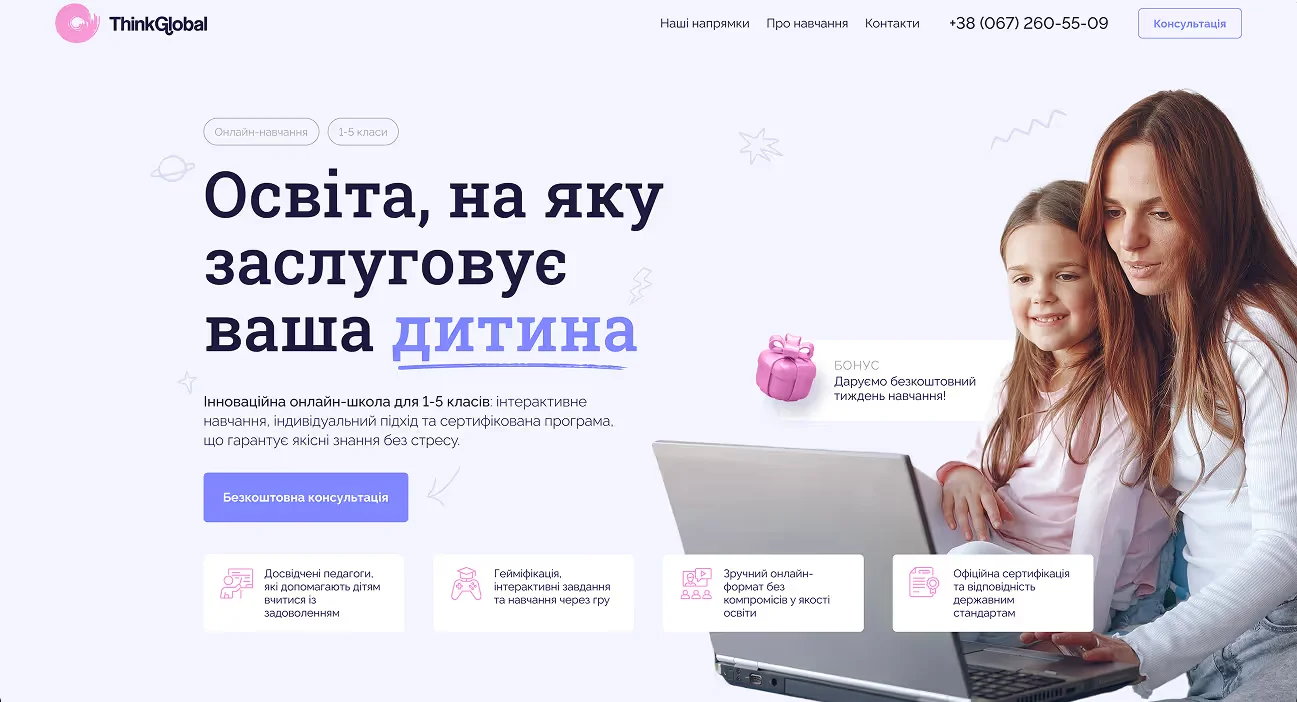
A clear example is our landing page redesign for the full-day online elementary school ThinkGlobal. The legacy page suffered from a dark, cluttered hero section with poor text legibility. Rather than complicating the site, we explored 4 focused hero concepts and shifted to a bright, high-contrast typographic hierarchy: right in the top visible viewport, parents see a crystal-clear value proposition, a prominent risk-free hook ("BONUS: Free trial week of schooling!"), and 4 visual 3D benefit cards establishing academic trust (supported further down the case study by a traditional school comparison matrix and a 4-tier tuition table):

2. Nodes #2 & #3: Mobile Header, Interactive Plan Selector & Thumb Zone Form — The Easy4Busy Case Study
The second major revenue leak is the mobile-to-desktop conversion gap. Many sites convert at 3.8% on desktop but plummet to 0.7% on smartphones (which account for 82%+ of Meta and Google Ads clicks). The culprits are bloated mobile headers that consume half the screen and complex product selectors that cannot be operated with one thumb.
We solved this exact problem during the redesign and mobile adaptation for healthy meal delivery service Easy4Busy. Replacing a pale template, we engineered a vibrant mobile experience tailored for 375px viewports: the first screen surfaces direct `2 trial days` and `Nutrition programs` buttons; the second screen presents touch-friendly calorie program selectors (`Express Fit 800 kcal`, `Slim 1000 kcal`, `Fitness 1300 kcal`), weekday tabs (`Mon..Sun`), and daily pricing tiers; the third showcases packaged meal cards with calorie badges (`Breakfast 388 kcal`); and the fourth delivers a vertical mobile order form (`Order right now`) with a 7% trial discount checkbox:


3 Scenarios Where Tweaks Are Powerless: Legacy Tech Debt, Broken Mobile DOM & Business Model Pivot
Conversely, some founders waste $500/month for years putting band-aids on a 2016 codebase that is structurally beyond repair. Knowing when to redesign a website b2b in full comes down to three non-negotiable architectural conditions.
1. Conditions #1 & #2: Terminal Tech Debt (LCP > 4.5s) & Non-Responsive Legacy Markup
Surgical CRO tweaks cannot save a platform whose foundation is structurally broken:
Legacy Monolith or Plugin Bloat: The site runs on an outdated WordPress/Elementor theme, Joomla, or a custom 8-year-old CMS weighed down by 45 conflicting plugins. Server response time (TTFB) exceeds 1.8s and mobile 4G Largest Contentful Paint (LCP) drags past 4.8–6.5 seconds. Rewriting hero copy will not help if 45% of paid clicks abandon the white loading screen before a single font renders.
Broken Mobile DOM: If the legacy site was built with fixed desktop tables or brittle CSS overrides where fixing a mobile button breaks the desktop layout, rebuilding on a clean modern stack (Next.js / React) is faster and cheaper than paying developers to fight spaghetti code.
2. Condition #3: Enterprise Repositioning & Multi-Segment B2B Funnel Separation — The PulsarAds Case Study
A full redesign is mandatory when your business model outgrows your old skin: expanding into Western enterprise markets, tripling average contract value, or serving distinct B2B buyer personas that cannot be converted on a single generic page.
This was the exact catalyst behind our full corporate platform redesign for Prague-based international affiliate network PulsarAds. Their legacy site relied on dated flat 2D vectors that failed to inspire trust among high-volume media-buying teams and enterprise advertisers. Following deep competitor research, UX wireframing, and 4 visual concept explorations, we architected a new multi-page platform in a dark neon aesthetic. Right in the primary hero viewport, visitors see proof of network scale (`2000+ Offers`, `$60 000 000+ Earning partners`), floating glassmorphic partner payout cards with live sparklines (`$57,892`, `$65,123`), and dual conversion CTAs (`Launch campaign` for advertisers vs. `Get offers` for affiliates) routing into dedicated B2B funnels:

The 10-Minute Diagnostic Matrix: 8 Questions to Decide with Mathematical Certainty
Before signing an agency contract, compare the 6-month capital math below and run your site through our 8-question diagnostic scorecard.
Blind $11,000 Full Website Rebuild vs. $2,400 14-Day Surgical UX/CRO Sprint (6-Month Horizon on $4,000/mo Ad Spend)
- Upfront Rebuild CapEx: $11,000 (includes 25 secondary pages with zero lead-gen impact)
- 4-Month Launch Lag (Opportunity Cost): Paid ads keep bleeding at 1.3% CVR for 120 days while waiting
- Foregone Net Margin During 4-Month Build: −$19,440 in missed profit vs. shipping a 14-day sprint
- Post-Launch SEO Migration Volatility: 25%–35% organic traffic drop for 6–8 weeks during URL re-indexing
- True Net Financial Break-Even: Month 7–8 after project kickoff
- Diagnostic & Surgical UX/UI Sprint Cost: $2,400 (saves $8,600 in upfront capital immediately)
- Time to Production Deployment: 14 days (zero downtime for paid ads or sales reps)
- Conversion Rate Uplift (1.3% → 3.8%): 76 leads/mo instead of 26 on the exact same $4,000 ad budget
- Organic SEO & Ad Pixel Continuity: 100% preserved URLs, meta tags, and trained Meta/Google pixel data
- Total 6-Month Financial Advantage: +$33,350 ($8,600 saved CapEx + $24,750 cumulative net profit)
When your underlying codebase is sound, a 14-day surgical UX sprint saves $8,600 upfront and generates $18,000 in extra net profit during the 4 months a traditional agency would spend rebuilding the site from scratch.
The 8-Question Executive Scorecard: Surgical Sprint vs. Full Rebuild
Score your current website across these 8 engineering criteria. If 5 or more answers fall into the left column, you only need a surgical sprint. You can also run an automated 2-minute assessment in our interactive Redesign vs. Surgical Tweak Diagnostic Tool.
| # | Diagnostic Question | Green Signal → Surgical UX Sprint ($1.5k–$3.8k) | Red Signal → Full Website Rebuild ($8k–$20k+) |
|---|---|---|---|
| 1 | What is your mobile 4G LCP speed? | Under 2.2 seconds (or fixable via asset optimization) | Over 4.5 seconds due to legacy CMS core and plugin bloat |
| 2 | Has your business model or ICP pivoted? | No, selling the same core offer to the same target buyer | Yes, moving upmarket (Enterprise/Export) or splitting B2B personas |
| 3 | Where do visitors drop off in GA4? | Isolated to 1–2 specific steps (Hero bounce, pricing, or form) | Uniformly severe bounce rates (85%+) across all pages and devices |
| 4 | How stable is your 375px mobile DOM? | Responsive grid exists, but header/CTA ergonomics are poor | No responsive grid, or editing mobile styles breaks desktop views |
| 5 | Does the site rank in Google Top 10? | Yes, strong organic traffic and backlink authority to protect | Zero organic traffic, or chaotic unindexed URL parameters |
| 6 | How modular is the frontend code? | Component-based (React, clean CMS theme, or Webflow) | Undocumented spaghetti code where changing a button takes 3 days |
| 7 | Does the visual brand repel B2B buyers? | Clean baseline style that just lacks sharp offer hierarchy | Looks like an abandoned 2014 site that fails enterprise vendor audits |
| 8 | What is your required ROI timeline? | Need lower CPL and higher lead volume within 2–3 weeks | Have a 3–5 month runway for a foundational platform overhaul |
How to Protect Existing SEO Rankings During a Redesign & Prevent Organic Traffic Drops
If your diagnostic confirms that a full architectural rebuild is unavoidable, the #1 engineering priority is protecting your historical Search Equity. Below is our mandatory 3-phase SEO preservation protocol.
1. Complete URL Crawl & 1-to-1 301 Redirect Mapping (Zero Soft-404s)
The most destructive post-redesign mistake is changing URL structures (e.g., from `/services/warehouse-automation.html` to `/solutions/warehouse`) and either leaving old URLs as 404s or redirecting all legacy pages en masse to the homepage. Google treats mass homepage redirects as Soft 404s and wipes out historical page-level rankings.
Before writing a line of new code, we export all indexed URLs via Google Search Console and Screaming Frog SEO Spider, audit high-authority backlink targets in Ahrefs, and construct a strict `1-to-1 301 Permanent Redirect` map with zero redirect chains or loops.
2. Semantic Parity, H1–H3 Hierarchy Preservation & Server-Side Rendering (SSR)
Designers frequently strip out 70% of on-page copy in the name of "minimalism" or hide critical specification tables inside client-side JavaScript tabs that fail to render for search crawlers. When Googlebot recrawls the page and finds key semantic entities missing, rankings plummet.
We enforce strict Semantic Parity: every traffic-generating page retains its proven `H1–H3` keyword hierarchy, expands rather than shrinks topical depth, renders 100% of HTML on the server via Next.js SSR/SSG, and preserves validated `JSON-LD` structured data (`Organization`, `Product`, `FAQPage`, `BreadcrumbList`).
3. Pre-Flight Launch Checklist & 14-Day GSC Indexation Monitoring
On launch day, we execute a 5-point technical verification:
Staging `noindex` Purge: Automated check of HTTP `X-Robots-Tag` headers and `<meta name="robots" content="index, follow">` tags.
Live `robots.txt` & XML Sitemap Submission: Immediate push of the new sitemap into Google Search Console.
Canonical Tag Integrity (`rel="canonical"`): Eliminating trailing-slash and UTM parameter duplicate indexing.
Production Core Web Vitals Verification: Confirming mobile LCP < 1.2s and CLS = 0.00 under live traffic.
72-Hour 404 Log Watch: Real-time server log monitoring to catch and redirect any edge-case broken links immediately.
Key Takeaways
Unsure whether your site needs a 14-day surgical UX sprint or a full architectural rebuild?
In 65% of businesses, an agency's $12,000+ full rebuild quote is unnecessary—a targeted 14-day UX/CRO sprint ($1,500–$3,800) delivers faster and higher ROI.
Surgically upgrading three high-leverage zones—the above-the-fold offer (like ThinkGlobal), mobile configurator, and Thumb Zone checkout (like Easy4Busy)—can triple conversion rates in two weeks.
A full redesign is only justified under three conditions: terminal tech debt (LCP > 4.5s), non-responsive legacy code, or a fundamental business model pivot requiring split B2B funnels (like PulsarAds).
Whenever a full rebuild is required, strict 1-to-1 301 redirect mapping, semantic H1–H3 parity, and Next.js SSR are mandatory to prevent a 30%+ organic SEO drop.