Corporate B2B Websites
Corporate B2B Website Cost & ROI: How Manufacturing & Export Leaders Capture Enterprise Contracts
Why multi-million-dollar manufacturers lose enterprise tenders over an $800 brochure website
Across industrial manufacturing, agricultural export, engineering, and commercial construction, a costly myth persists: 'Our buyers come from trade shows in Munich or Chicago and personal referrals, so our website is just a digital business card.' Yet Gartner B2B buying research proves the exact opposite: 67% of enterprise buyers prefer a rep-free research experience, completing nearly three-quarters of vendor shortlisting online before ever speaking to a sales engineer. When a German or US procurement officer looks up your factory after a trade fair and encounters a broken 2016 layout, generic stock photos of smiling workers in hardhats, and zero downloadable technical data sheets (TDS), your company is silently disqualified from the Request for Proposal (RFP) shortlist.
When executives evaluate the true b2b corporate website design cost, they are not buying 'pretty web pages'—they are investing in an automated vendor-prequalification and RFQ capture engine. In this breakdown, we examine a transparent enterprise website development budget, map the exact requirements of 6-to-10-person buying committees, and demonstrate across 4 real portfolio cases how manufacturing website redesign roi pays back the entire build from a single closed contract.
Why B2B Websites Are Evaluated by a Buying Committee—Not Impulse Buyers
In retail e-commerce, one person buys a $120 pair of shoes in three minutes based on emotion. In industrial B2B, a $150,000–$1,000,000+ supply contract for polymer membranes, grain elevator systems, or structural engineering is vetted by a Buying Committee averaging 6 to 10 internal stakeholders. Explore our complete engineering framework inside the Corporate B2B & Export Websites hub.
1. The 4 Buying Committee Roles & What Disqualifies You in 45 Seconds
Understanding b2b lead generation website cost and architecture starts with serving four distinct evaluators simultaneously:
Lead Engineer / Technical Specifier: Demands exact tolerances, material grades, CAD/BIM files, operating temperature ranges, and downloadable PDF spec sheets. Vague claims about 'superior quality' trigger an immediate veto.
Procurement & Supply Chain Director: Verifies monthly production capacity, warehouse locations, Incoterms (FCA, DAP, DDP), and lead-time reliability.
Legal & Compliance Auditor: Checks active ISO 9001, CE, TÜV, or RoHS certifications, GDPR compliance, and statutory corporate disclosures (such as Germany's mandatory Impressum).
CFO / Economic Buyer: Evaluates company longevity, engineering headcount, verified project budgets, and Total Cost of Ownership (TCO).
2. Engineering Trust Funnel for the German Market: The IBR Case Study
Western enterprise buyers spot visual fluff instantly. Authority in DACH and North American markets is built through documented heritage, engineering headcount, and structured project passports.
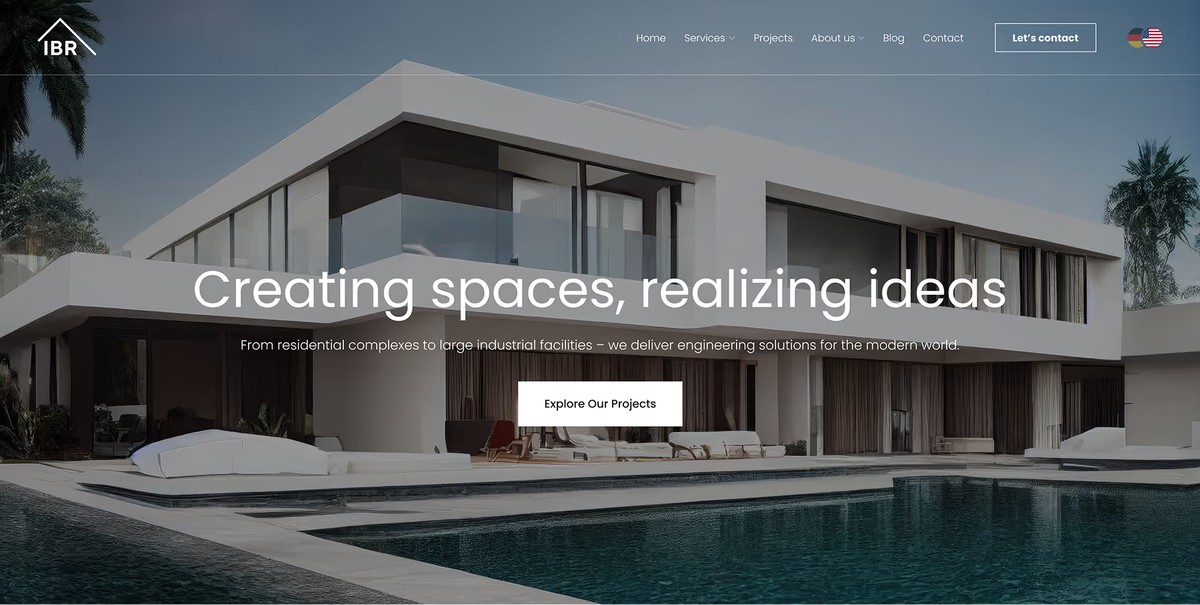
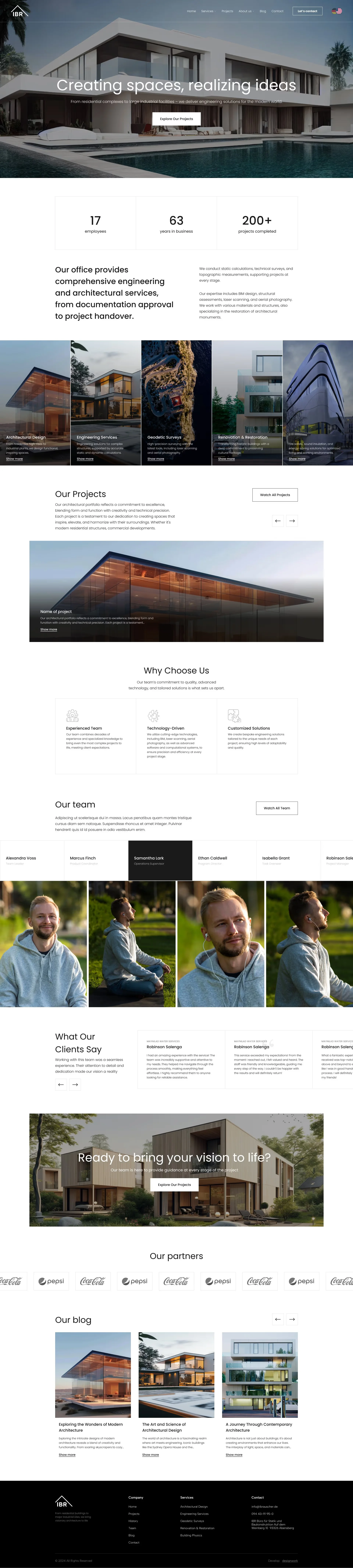
A prime example is the turnkey corporate website we designed and built on Webflow for IBR, an architectural and structural engineering firm based in Abensberg, Germany. Operating since 1961, the firm delivers BIM modeling, structural calculations, and surveying for industrial and municipal developments. We architected the homepage as a sequential trust funnel for buying committees: immediately below the hero, hard institutional metrics establish authority (`63 years in business`, `17 in-house engineers`, `200+ completed projects`), followed by 5 structured engineering verticals and a CMS-driven project catalog where every case study features a standardized technical passport (completion year, client, budget, location, and delivered scope):
Transparent Budget Breakdown: What Drives Industrial Company Web Design Pricing
Why does a freelancer quote $1,200 for a WordPress theme while a custom B2B enterprise web platform ranges from $6,500 to $18,000+? The difference lies in whether the platform can pass technical and procurement due diligence. Here is a transparent breakdown of industrial company web design pricing across five engineering phases.
1. Cost Allocation Across 5 Engineering Phases
Every dollar in a B2B corporate build maps to measurable commercial infrastructure:
Competitor Benchmarking & Buying-Committee UX Architecture (18% — $1,200–$3,000): Auditing 10 direct EU/US competitors, mapping user journeys for engineers and procurement officers, and wireframing interactive Figma prototypes for all core templates.
Bespoke Industrial UI System & Data Visualization (25% — $1,800–$4,500): Crafting an authoritative visual language, specification matrices, interactive supply-chain maps, dark/light themes, and ergonomic 375px mobile layouts.
Frontend Engineering (Next.js / Webflow) & 95+ Core Web Vitals (30% — $2,200–$5,500): Clean component architecture, hardware-accelerated GSAP micro-interactions, sub-second page loads (`LCP < 1.1s`), WebP asset pipelines, and enterprise security headers.
Multi-Language International SEO & Schema.org Graph (15% — $1,000–$2,500): Multi-locale routing (`en`, `de`, `pl`, `uk`) with strict `hreflang` mapping, `Organization` and `Product` JSON-LD schemas for Google and AI search engines (ChatGPT / Perplexity), and GDPR/Impressum compliance.
CRM/ERP Integration & Interactive RFP Configurator (12% — $800–$2,500): Routing structured technical inquiries and blueprint attachments directly into HubSpot, Salesforce, or your custom CRM with automatic company-domain enrichment.
2. Side-by-Side Comparison of B2B Website Tiers
| Evaluation Metric | Cheap Template ($800–$2,000) | Generic Web Agency ($2,500–$5,000) | Engineered B2B Enterprise Portal ($6,500–$18,000) |
|---|---|---|---|
| Primary Architecture Goal | 'Just having a link on business cards' | Generic brochure copy aimed at retail | Engineered for 6–10 person B2B buying committees |
| Product Catalog & Specs | Static text or a single 50MB PDF file | Retail e-commerce cart layout | Filterable spec matrices, TDS sheets, CAD/BIM downloads |
| Lead Capture Mechanism | Basic 'Name + Phone' form (0.2% CR) | Annoying callback pop-ups | Step-by-step RFP / Cost Estimator Quiz (2.4–3.8% CR) |
| Performance & Security | 40+ vulnerable plugins, PageSpeed 38/100 | Average load times, heavy DOM bloat | Next.js / Webflow, PageSpeed 95–99/100, SSL/GDPR ready |
| EU/US Auditor Perception | Looks like a shell middleman (disqualified) | Generic stock photos erode trust | Tier-1 industrial supplier authority |
RFP Capture Architecture: Turning a Dead Contact Form Into an Interactive Spec Configurator
The single biggest conversion leak on 90% of industrial websites is ending a technical equipment page with a generic 'Leave your phone number and we will call you' form. Enterprise buyers managing $100,000+ budgets refuse to waste 40 minutes explaining basic parameters to a junior sales rep over the phone.
1. Why 'Call Me Back' Forms Kill Up to 80% of High-Ticket B2B Inquiries
When a plant director or project engineer evaluates suppliers, they open 5 to 7 vendor websites in parallel. If four vendors only offer a generic `info@...` email address while the fifth provides a 60-second interactive configurator to select capacity, site dimensions, or material volume and receive a structured cost breakdown, that fifth vendor captures the lead and anchors the entire tender.
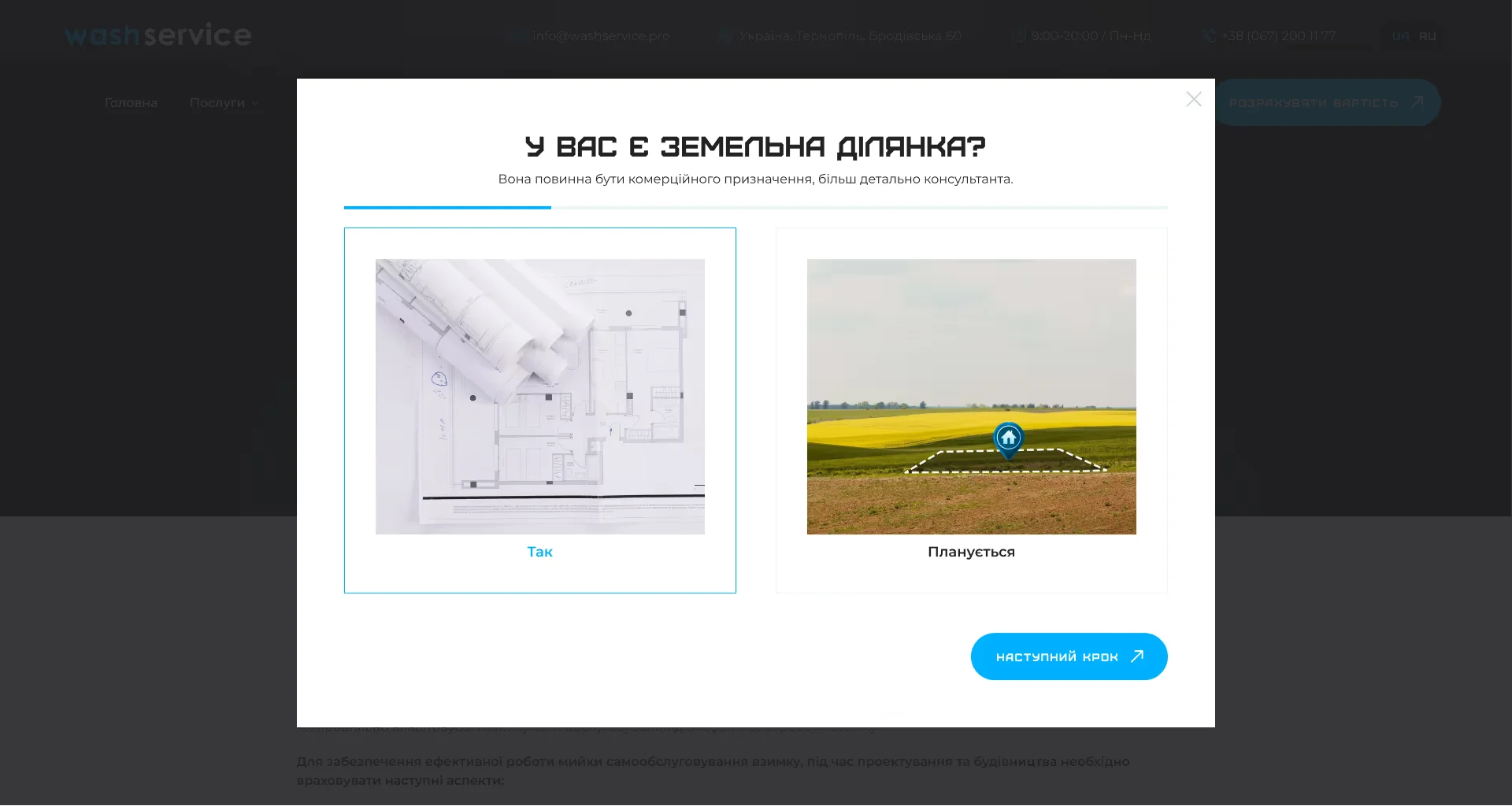
2. Step-by-Step Investor Cost Estimator Quiz: The WashService Case Study
Replacing a static contact form with an interactive specification and cost configurator lifts high-intent B2B conversion rates from 0.4% to 3.2% while pre-qualifying budget size for your sales engineering team.
We engineered this exact conversion engine for WashService, a turnkey builder of self-service car wash complexes with 78+ completed facilities. Because constructing a multi-bay complex requires substantial capital expenditure, prospective investors hesitate to submit blind contact forms. We embedded a 3-step interactive cost estimation quiz directly into the corporate platform: investors specify land availability, select the desired number of wash bays (1 to 8) on a visual selector, enter their city, and choose their preferred messenger to receive a tailored PDF construction budget and 1.5-year ROI payback model:
Visualizing Industrial Scale: Real Production Lines, ISO Specs & Mobile Field Ergonomics
The second major barrier in enterprise sales is buyer fear of dealing with an under-capitalized middleman. Your digital platform must visually prove physical infrastructure, warehouse footprint, and material compliance.
1. Digitizing Technical Material Specs & Applications: The Polymer Consulting Case Study
In industrial raw materials, chemicals, and technical textiles, procurement teams buy verified physical tolerances and application-specific material grades. Burying those specs inside unstructured paragraphs costs you wholesale distributors.
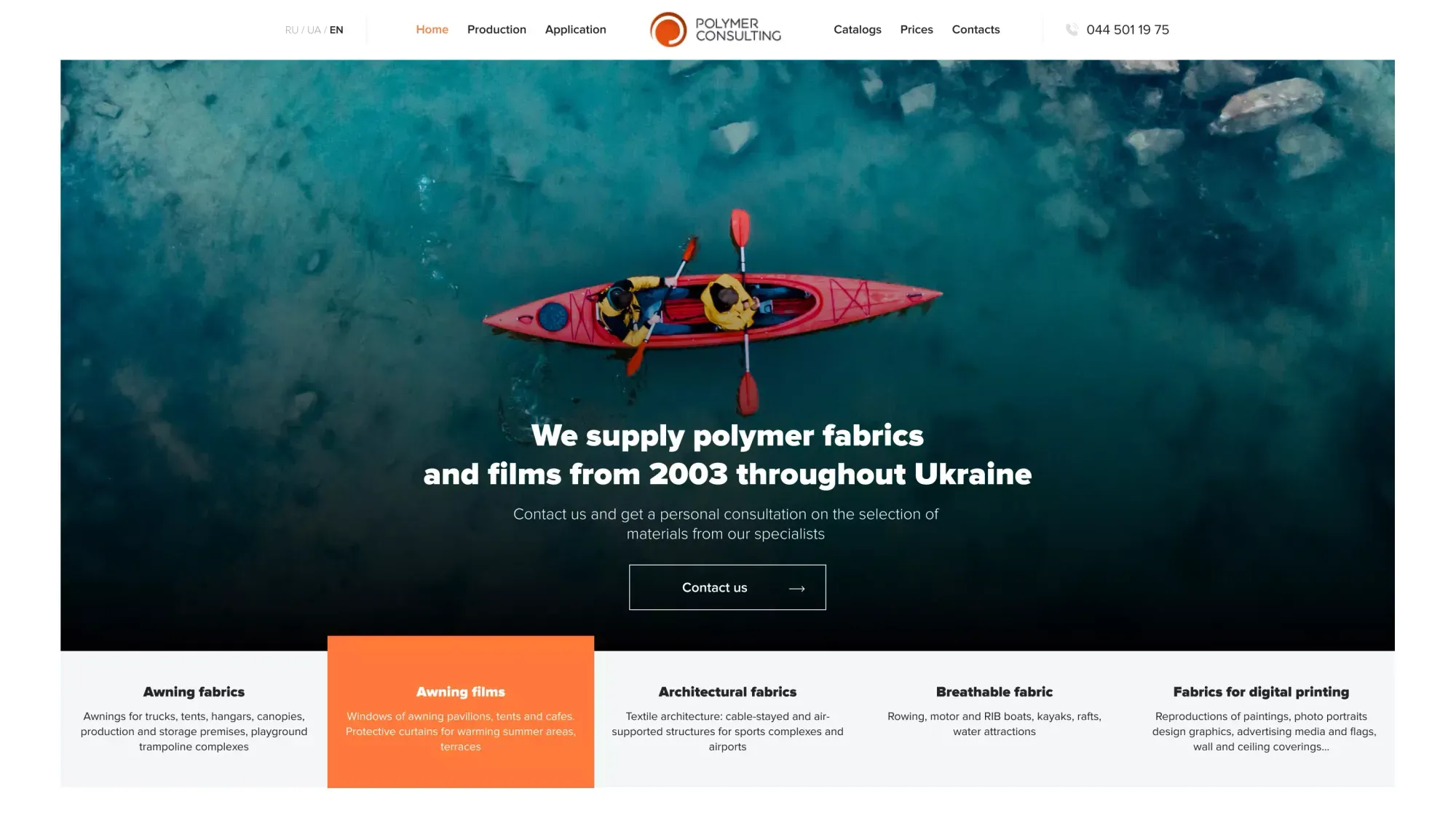
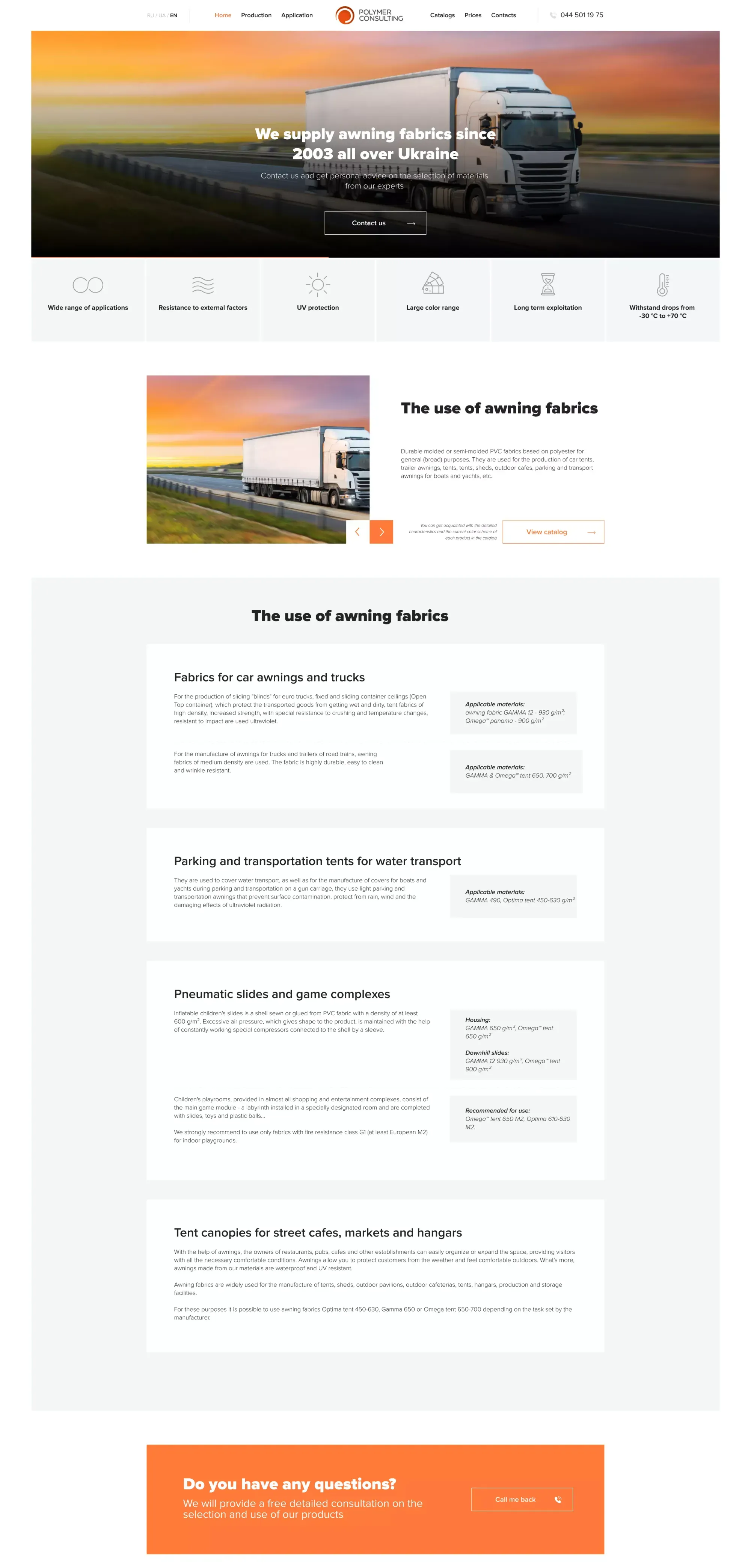
When designing the corporate platform for Polymer Consulting, a major B2B supplier of industrial polymer fabrics and films, we replaced generic marketing copy with hard engineering data. Every product vertical page (shown below for the PVC awning fabric division, `We supply awning fabrics since 2003 all over Ukraine`) functions as a structured technical datasheet: immediately below the hero banner, a 6-icon technical strip highlights operating properties (`UV protection`, `Withstand drops from -30 °C to +70 °C`, `Resistance to external factors`, `Long term exploitation`) alongside a direct `View catalog` transition, followed below by an application matrix specifying exact PVC fabric density grades (`GAMMA 12 — 930 g/m²`, `Omega panama — 900 g/m²`, `Optima tent 450–630 g/m²`):
2. Mobile Field Ergonomics (375px / Thumb Zone) for Agribusiness & Logistics: The JetAgro Case Study
It is a costly mistake to assume B2B websites are only viewed on office desktops. In agribusiness, grain logistics, construction, and heavy equipment, over 62% of initial visits from farm directors, site engineers, and fleet operators happen on smartphones in the field or at grain elevators.
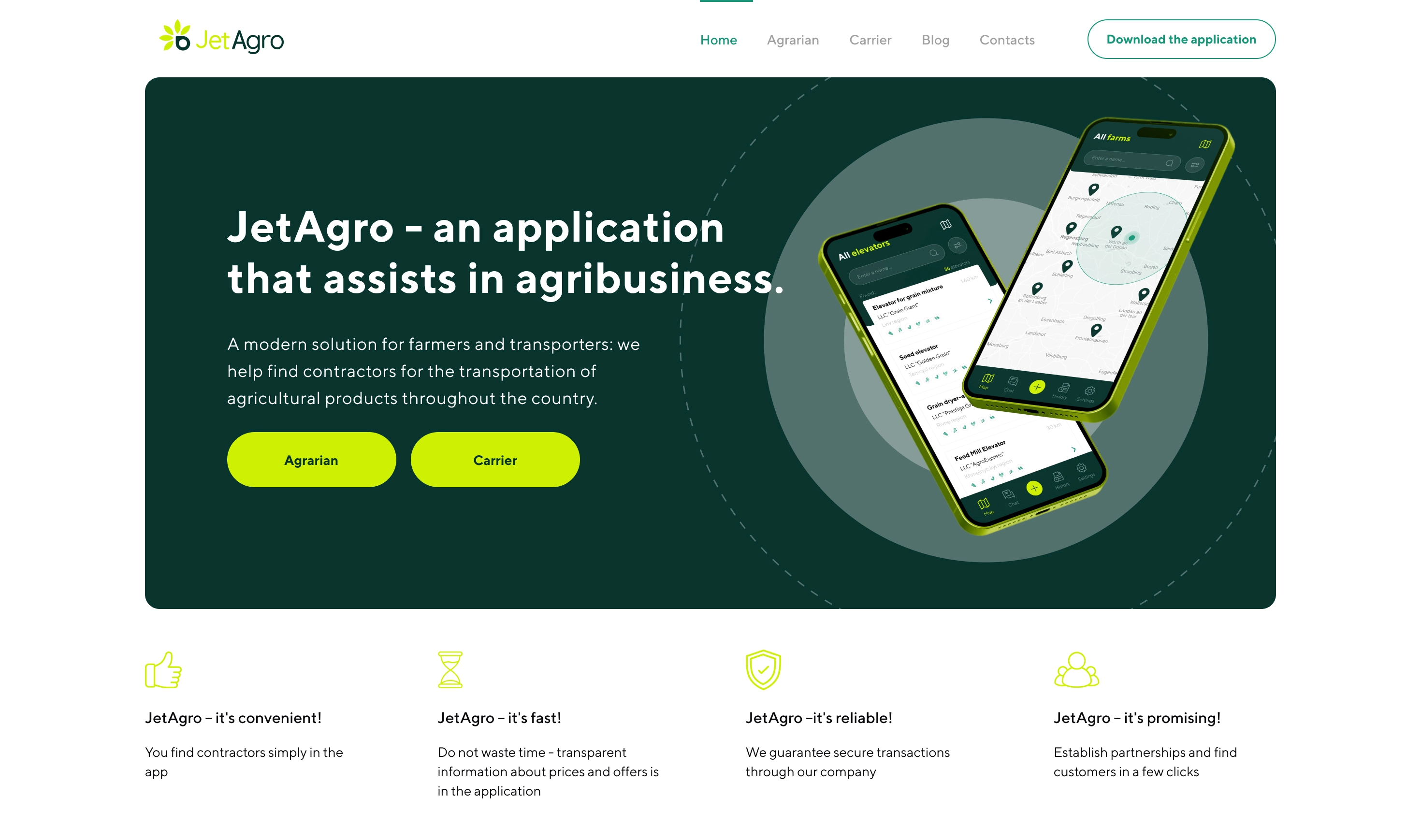
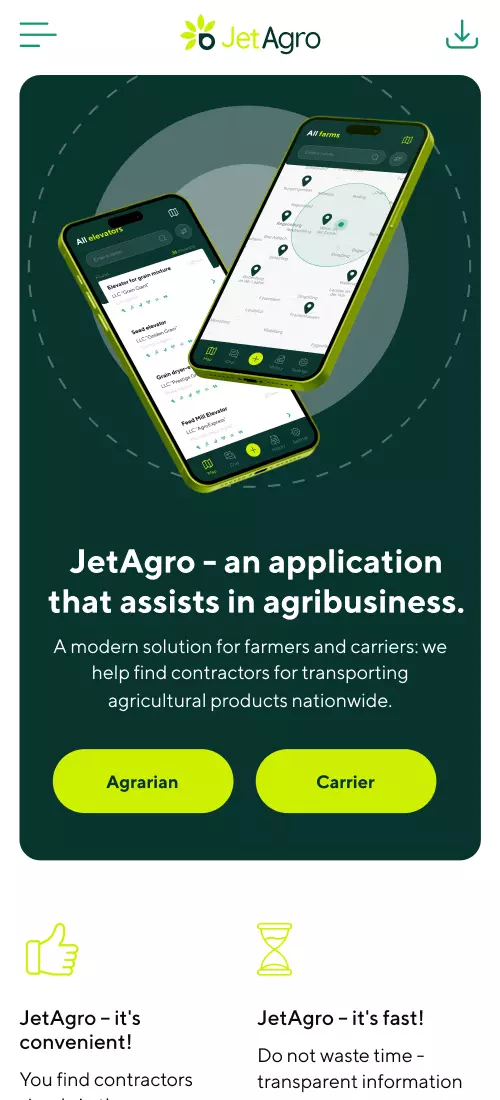
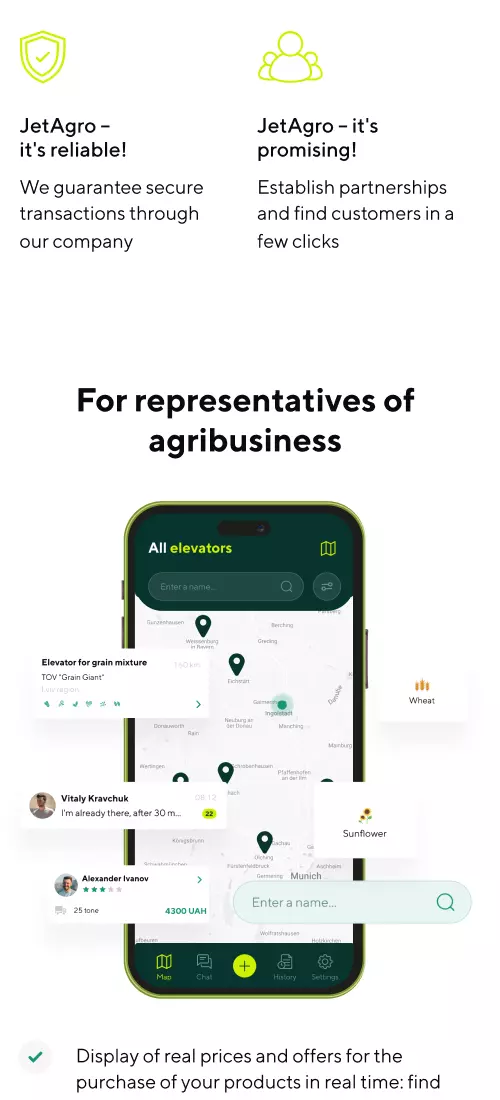
When designing the corporate website for JetAgro, an agribusiness logistics platform connecting grain producers, elevators, and carriers, we prioritized mobile ergonomics (`375px`). The four mobile screens below illustrate how visitors are segmented immediately on the hero screen via thumb-friendly `Agrarian` and `Carrier` role buttons, followed by an annotated `All elevators` real-time map preview displaying carrier freight bids (`25 tone — 4300 UAH`), a high-contrast `Apple Store / Google Play` conversion card, and an 8-crop selection grid (`Barley`, `Wheat`, `Sunflower`, `Corn`, `Soy`, `Pea`, `Turnip`, `Linen`):


ROI Payback Math: How a Single $150k Contract Pays for Your New Website in Q1
Let's evaluate manufacturing website redesign roi through strict unit economics. Unlike consumer e-commerce that relies on thousands of small carts, an industrial B2B platform compounds returns through high contract Lifetime Value (LTV).
Legacy Brochure Site vs. Engineered B2B Portal: 12-Month Pipeline Math for a Manufacturer
- Visitor-to-RFP Conversion Rate: 0.3% (mostly low-intent retail inquiries)
- Enterprise Committee Prequalification: Rejected due to missing TDS/ISO specs & slow UI
- Qualified RFPs Captured per Year: 54 inquiries (4.5/mo)
- Closed Contracts per Year (12% Win Rate): 6.4 contracts ($960,000 gross revenue)
- Annual Opportunity Cost: −$324,000 in missed net manufacturing margin
- Visitor-to-RFP Conversion Rate: 1.2% via interactive spec configurator & datasheets
- Buying Committee Trust Score: Full documentation (TDS, CAD, ISO, Impressum)
- Qualified RFPs Captured per Year: 216 tender inquiries (18/mo)
- Closed Contracts per Year (12% Win Rate): 18+ contracts ($2,700,000+ gross revenue)
- Full Investment Payback ($9,500): Paid back 2.8x over from the very 1st closed deal
Even if a $9,500 turnkey corporate B2B platform helps your manufacturing or engineering firm win just ONE additional $150,000 contract all year, the $27,000 net margin from that single deal pays back the entire website investment nearly three times over in Q1.
Benchmark Your Current Site Against 3–5 Competitors in 2 Minutes
Before allocating budget for a redesign, see how your company stacks up against direct industry rivals across objective technical metrics: mobile PageSpeed, SSL and legal compliance, clicks-to-spec-sheet, and RFQ capture friction.
Run a live side-by-side audit right now using our free engineering tool: the B2B Competitor Website Scanner. Enter your domain alongside 3 domestic or European competitors to get an instant comparative scorecard.
Key Takeaways
Ready to expand into EU & US tenders and turn your corporate website into an enterprise contract engine?
Enterprise B2B purchases are vetted by 6–10 person buying committees (engineers, procurement, legal, CFO) who complete 67% of vendor evaluation independently on your website.
A transparent B2B corporate website budget ($6,500–$18,000) covers buying-committee UX architecture, filterable technical datasheets, an interactive RFP configurator, and multi-language SEO.
Replacing generic 'Call Me Back' forms with a 3-step specification or cost estimator quiz multiplies qualified tender inquiries by 3x–4x.
With an average B2B contract value of $150,000, a turnkey corporate platform achieves 284% ROI from the very first closed deal.