Corporate B2B Websites
Commercial Construction & EPC Engineering Website Design: Showcasing Projects, Fleets, Winning Tenders, Budget & ROI
Why general contractors with million-dollar fleets lose $2M+ tenders before submitting a single bid
In commercial construction, industrial civil engineering, and large-scale EPC (Engineering, Procurement, and Construction) contracting—where project budgets span $500,000 to $10,000,000+ for Class-A logistics hubs, grain elevators, manufacturing plants, and commercial developments—contract awards are never decided by a single buyer browsing on impulse. Your company is evaluated by a multi-disciplinary procurement committee: the VP of Capital Projects (CapEx), Lead Structural Engineer, Corporate Risk & Compliance Officer, and Chief Financial Officer. Before your estimating team is ever invited to download a private Request for Proposal (RFP) or Bill of Quantities (BOQ), a procurement analyst spends 120 seconds auditing your website against a binary Prequalification (Pre-Q) checklist: Does this firm hold verified high-consequence construction licenses and ISO certifications? Have they delivered comparable square footage as Prime Contractor over the past 5 years? Do they own heavy earthmoving and crane assets, or are they an under-capitalized middleman broker?
When construction executives evaluate commercial construction website design, they quickly realize why a generic $1,000 template filled with stock photos of smiling workers in spotless hardhats generates zero enterprise inquiries. Architecting a high-trust epc engineering contractor website means digitizing your heavy fleet, structural engineering capabilities, safety record (TRIR/LTIFR), and tender history into an interactive prequalification engine. Below, we break down the exact blueprint of a tender-winning construction portal—illustrated with real case studies we built in Germany and Eastern Europe—alongside mobile jobsite optimization and 12-month ROI math.
How Developers & Institutional Investors Vet General Contractors Before Issuing a Private RFP
Across private commercial development and international reconstruction tenders (EBRD, World Bank, IFC, USAID, and industrial park developers), up to 70% of prospective contractors are eliminated during silent digital screening before the shortlist (Approved Vendor List — AVL) is finalized. To see how we engineer digital platforms that pass strict Western procurement audits, explore our Corporate B2B & Export Websites hub.
1. The 4-Gate Procurement Committee Screening Protocol
When a developer's tender committee audits an unfamiliar contractor's website, they look for four non-negotiable proof points:
Track Record Parity: An investor building a 200,000 sq.ft. cold-storage distribution center will immediately disqualify a contractor whose portfolio shows only uncaptioned exterior photos without gross floor area (`m² / sq.ft.`), structural steel tonnage, completion timelines, and explicit contract role (Prime EPC Contractor vs. Specialty Subcontractor).
In-House BIM & Value Engineering Capability: Institutional clients verify whether your firm operates an in-house engineering department proficient in Revit, Tekla Structures, and AutoCAD Civil 3D—capable of running clash detection and value-engineering foundation or MEP costs without compromising structural integrity.
Asset Ownership & Bonding Capacity: Verifiable proof of owned batching plants, tower cranes, formwork systems (Doka, Peri), and earthmoving fleets reassures the CFO that your company will not default after receiving a 30% mobilization advance.
Corporate & Legal Transparency: Clear registration identifiers (DUNS / Tax IDs), named executive leadership, and direct tender desk contacts.
2. Engineering Trust for European Industrial Clients: The German IBR Case Study
To pass Western European and enterprise due diligence, a construction or engineering website must project institutional authority within the first 5 seconds—replacing vague marketing slogans with hard metrics and documented industrial heritage.
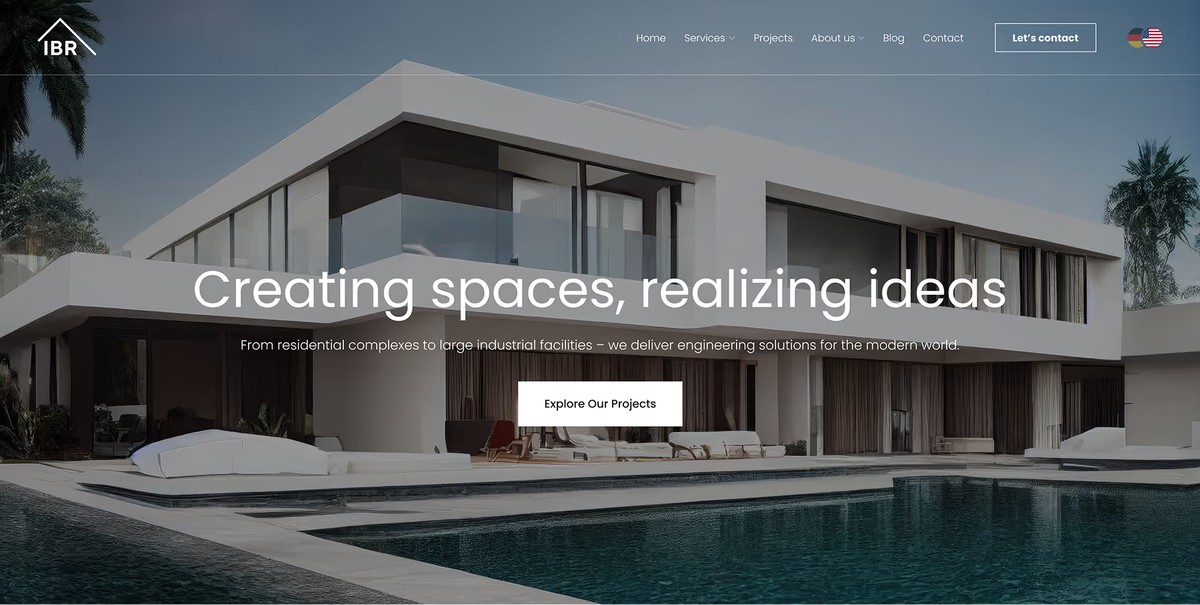
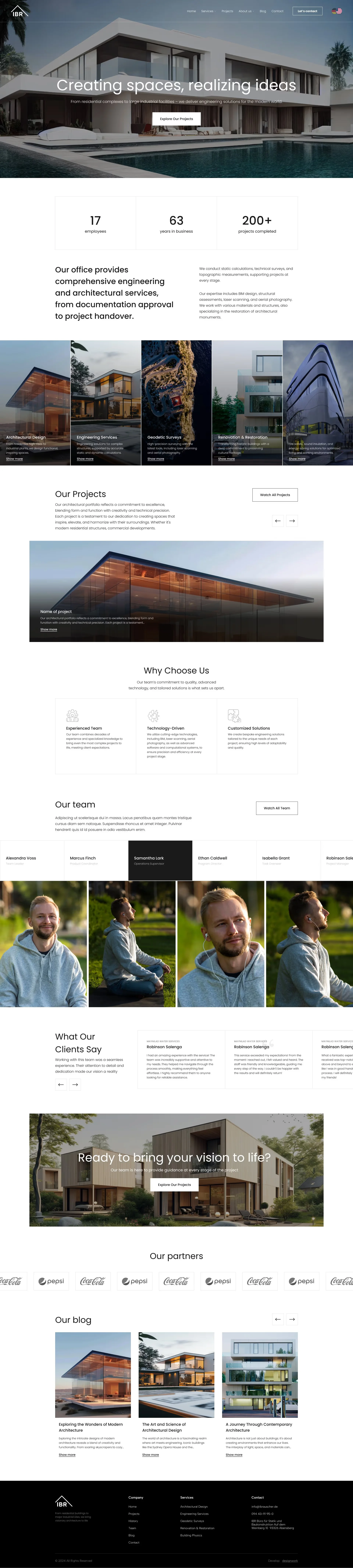
We engineered and built this exact trust architecture on Webflow for the German architectural and civil engineering firm IBR (headquartered in Abensberg, Germany). Above the fold, we anchored authority using concrete operational numbers (63 years of continuous engineering heritage since 1961, 17 in-house certified engineers, and 200+ commissioned industrial and commercial facilities), structured their 5 core engineering verticals (BIM modeling, structural calculations, industrial planning, and surveying), and built an interactive historical timeline pairing archival plant construction photography with modern EPC milestones:
3. Comparison Matrix: Why Template Websites Fail $500k–$5M+ Prequalification Audits
Here is how procurement committees score three tiers of contractor web presence when compiling a closed tender shortlist:
| Procurement Audit Criterion | Tier 1: Legacy Brochure / Template Site ($800–$1,500) | Tier 2: Generic Agency Corporate Site ($2,500–$4,500) | Tier 3: Custom EPC & Construction B2B Portal ($6,500–$15,000) |
|---|---|---|---|
| Project Portfolio Architecture | 10 uncaptioned photos lacking square footage or dates | Blog-style text posts without technical filtering | Parametric project registry with CAD/BIM specs, tonnage & drone time-lapses |
| Licenses, Safety & ISO Proof | Vague text claim: "Fully licensed & insured" | Low-res scanned JPEGs buried in a sub-menu | Verified Consequence Class (CC2/CC3) & ISO 9001/14001/45001 vault + 1-click Pre-Q ZIP |
| Fleet & Production Base Proof | Shutterstock photos of generic yellow excavators | Brief paragraph mentioning equipment availability | Structured asset catalog listing crane capacities, formwork m² & fabrication plants |
| RFP & Bid Capture Mechanism | Basic "Name + Phone" form (< 0.4% conversion) | Standard contact form with a message box | Interactive ROM Cost Configurator + NDA-protected BOQ / CAD drawing uploader |
| Jobsite Tablet Load Speed (4G) | 6.5–11.0s (uncompressed images, broken mobile grids) | 3.2–4.8s (bloated page builders & heavy plugins) | 0.8–1.2s (95+ Core Web Vitals, adaptive WebP & tiled floorplans) |
| Closed Tender Pre-Q Outcome | Eliminated during initial compliance screening | Requires days of manual email back-and-forth | Instant AVL prequalification & direct invitation to bid |
Interactive Project Maps & Parametric Filtering: Square Footage, Timelines, BIM Specs & Drone Telemetry
A contractor's strongest sales asset is commissioned square footage. Yet most firms fail at construction company portfolio architecture because they treat case studies like photo albums rather than engineering dossiers. A Chief Engineer reviewing your site wants verifiable technical specifications within 30 seconds.
1. Anatomy of an Engineering-Grade Project Case Study Sheet
Every project page inside a custom general contractor website redesign is structured as a standardized technical passport containing six mandatory data blocks:
Top Specification Bar (Hard Facts): Gross floor area (`sq.ft. / m²`), structural volume (`m³`), risk/consequence classification (`CC2 / CC3`), exact execution duration (14 Months: March 2024 – May 2025), location, client, and delivery model (Turnkey Design-Build / EPC).
Engineering Challenge: High water-table piling constraints, long-span 24-meter roof truss installation over an active production line, or strict cleanroom HVAC tolerances.
Quantified Scope of Works: 420 bored concrete piles driven, 6,500 m² of laser-screed industrial floor slab rated at 8 tons/m², and 380 metric tons of structural steel erected.
Interactive 'BIM Model / Blueprint vs. As-Built Photo' Slider: A draggable comparison proving 100% execution fidelity to structural drawings.
Drone Time-Lapse & Node Close-Ups: Aerial progress video paired with macro photography of structural welds, MEP manifolds, and transformer substations.
Verified Completion Certificate & Client Reference Letter.
2. Structuring Real Estate & Development Specifications: The Livingston Case Study
When architecting a platform for a commercial real estate developer or design-build hospitality contractor, institutional and private investors demand crystal-clear ROI horizons, operator credentials, and asset specifications right from the first screen.
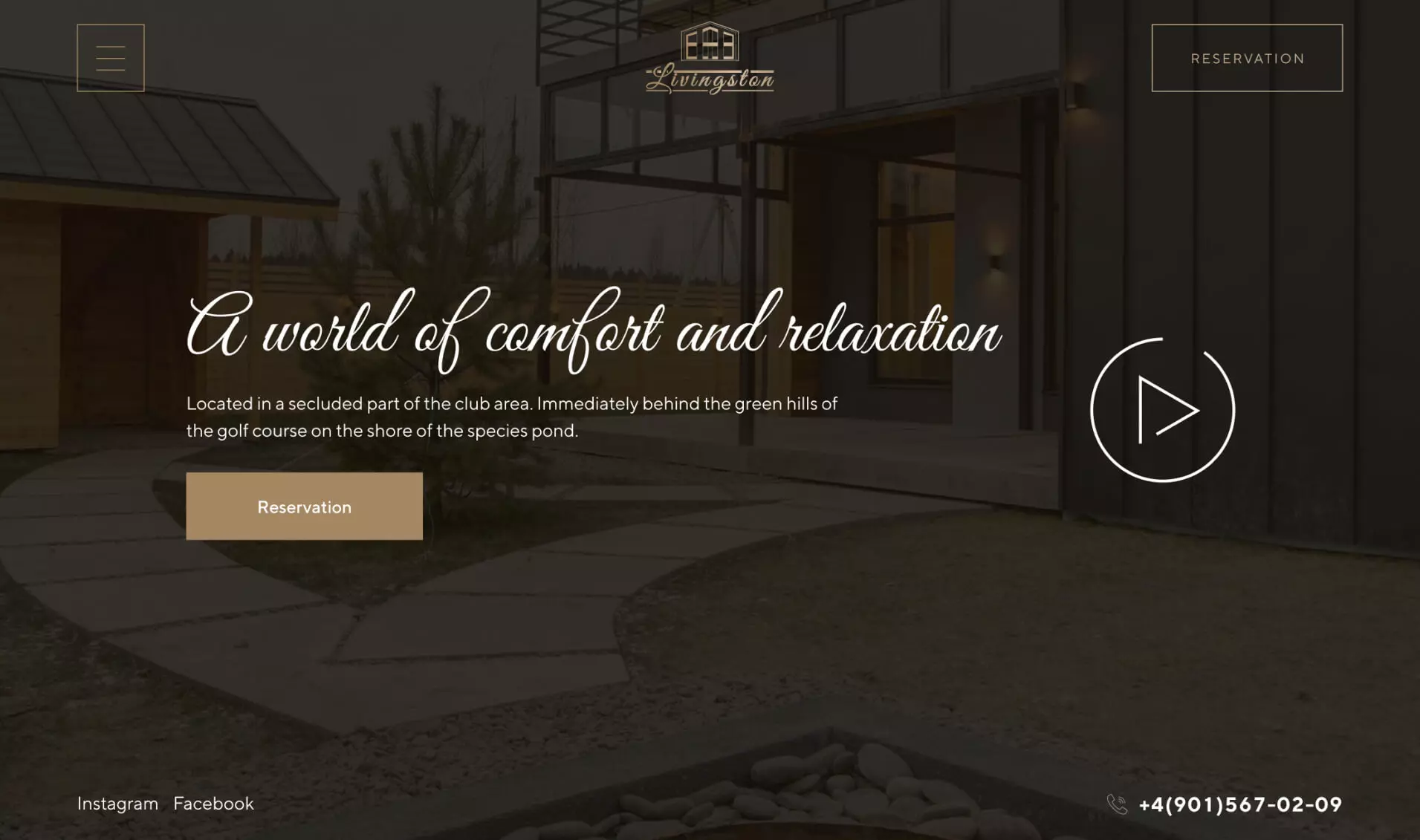
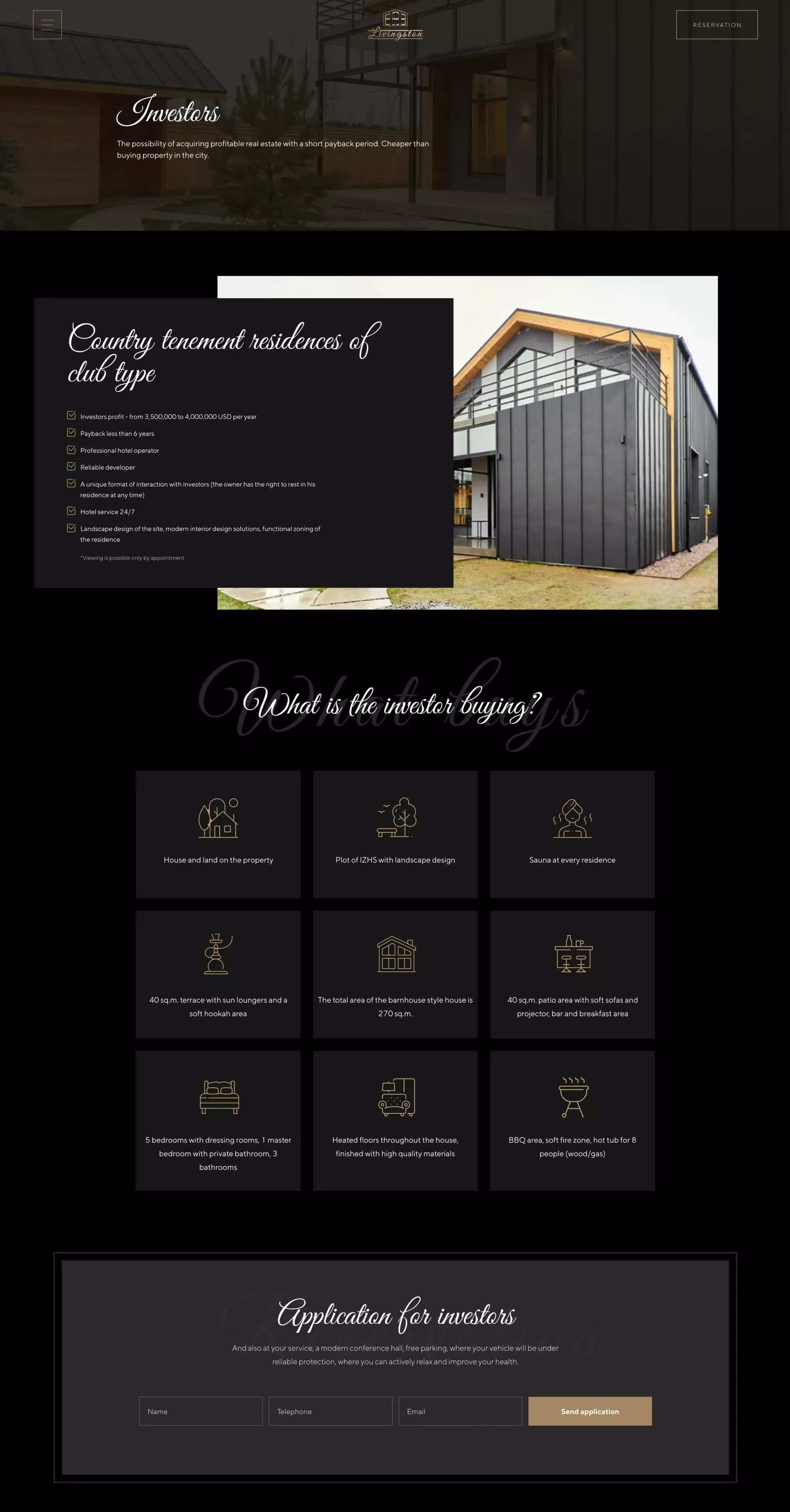
We implemented this structured investment presentation in the corporate platform for the private country club and residence development Livingston. Above the fold on the dedicated `Investors` page, we replaced generic promotional copy with a clear investment value proposition and the `Country tenement residences of club type` executive summary card (highlighting projected investor pool returns of `$3,500,000 to $4,000,000 USD per year`, a payback period of `less than 6 years`, a `Professional hotel operator` with `Hotel service 24/7`, and a `Reliable developer`), followed directly below on the page by a 9-card architectural specification grid detailing the `270 m²` residence footprint and `40 m²` terrace:
3. Multi-Axis Portfolio Filtering for Specialized Procurement Teams
When your firm has completed 50 to 200+ projects, an agricultural holding looking to build a grain elevator should not have to scroll through residential apartments. We build instant, zero-reload parametric filtering across four dimensions:
By Sector: Industrial & Manufacturing / Agro & Grain Elevators / Cold-Chain & Logistics Warehouses / Commercial Offices & Retail / Multi-Family Residential / Energy & Infrastructure.
By Delivery Scope: Full EPC Turnkey / Structural Concrete & Monolith / Steel Fabrication & Erection / MEP & Cleanroom Systems.
By Consequence Class: CC3 (High Consequence / Heavy Industrial) / CC2 (Medium Consequence).
By Status: Commissioned & Handed Over / Active Construction (Live Drone Feed).
Showcasing Production Capacity: Heavy Equipment Fleets, Precast Plants & Certified Engineering Staff
The biggest risk in commercial construction is awarding a contract to an under-equipped broker who subcontracts 100% of the work and delays commissioning by six months. A dedicated Production Base & Fleet Registry page eliminates this fear immediately.
1. Digitizing Your Heavy Fleet, Formwork Inventory & Fabrication Facilities
Instead of writing "We have modern equipment," we design an interactive asset catalog featuring branded on-site photography and technical specs:
Earthmoving & Lifting Fleet: Exact unit counts, models (Caterpillar, Liebherr, JCB, Manitou), excavator reach depths, and mobile crane lifting capacities.
Formwork & Scaffolding Inventory: Owned square meters of horizontal and vertical formwork (Doka, Peri) proving your ability to pour large floor plates simultaneously.
In-House Manufacturing Plants: Precast concrete (RC) facilities, structural steel fabrication shops (monthly tonnage output), mobile concrete batching plants, and certified non-destructive testing (NDT) labs.
Key Engineering Personnel Matrix: Profiles of your Chief Engineer, Project Directors, QA/QC Leads, and HSE Managers complete with state certification registry numbers.
2. Replacing Dead Contact Forms with a 3-Step Cost Configurator: The WashService Case Study
Standard construction websites convert below `0.3%` because a generic "Request a Call" button offers zero immediate value to a busy CapEx director. B2B buyers want a preliminary Rough Order of Magnitude (ROM) estimate or a structured way to submit project parameters.
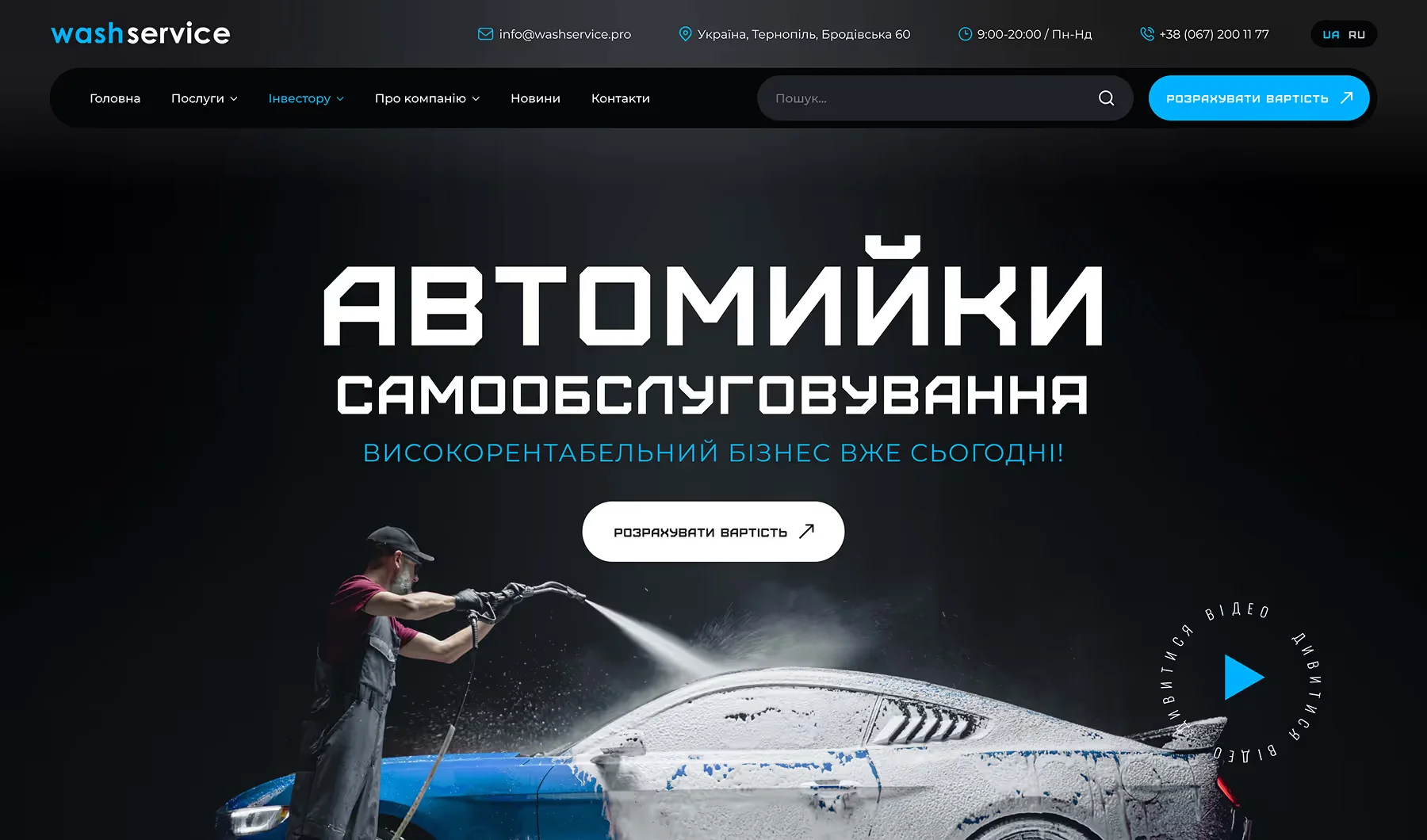
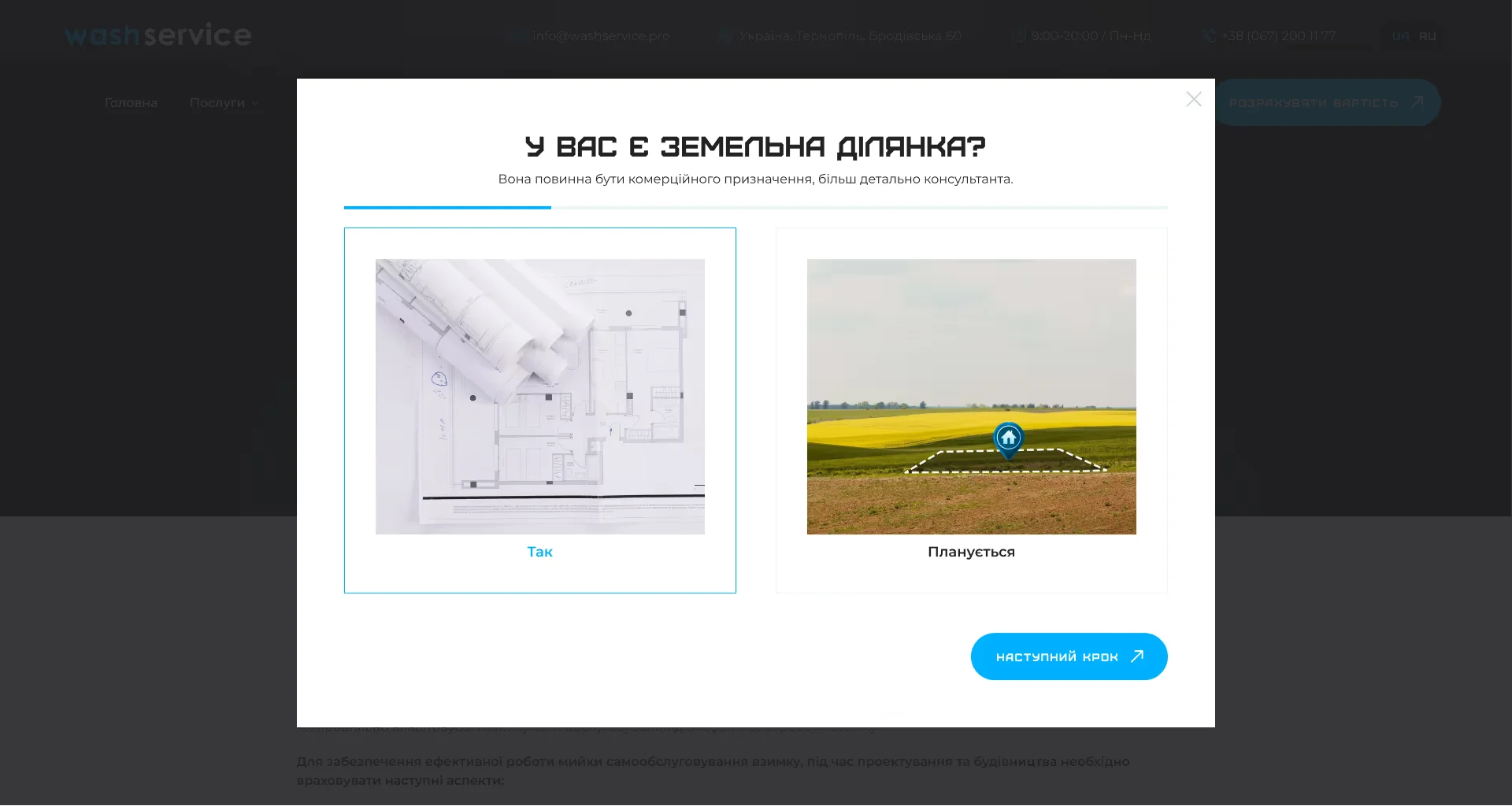
We engineered this high-converting B2B lead-capture architecture for WashService, a turnkey commercial car wash engineering and construction company (60+ complexes built). We structured dedicated landing pages for each engineering vertical (architectural modeling, steel canopy fabrication, European equipment supply, and turnkey construction) and embedded an interactive 3-step cost estimation quiz. Prospective investors select land availability, number of bays (1 to 8), and city location to receive an instant PDF construction estimate and ROI business plan:
Licenses, Consequence Classes (CC2/CC3), ISO Certifications & HSE Safety Records: De-Risking the Buyer
In civil engineering firm web design, the legal and compliance section is where procurement officers spend 40% of their review time. Whether bidding on public infrastructure tenders, EBRD-funded reconstruction, or multinational factory builds, missing compliance documentation triggers automatic disqualification.
1. The Mandatory Compliance Vault: CC2/CC3 Permits, High-Risk Licenses & ISO Standards
We build a dedicated Compliance, Licensing & HSE Vault featuring watermarked high-resolution certificates linked directly to state verification registries:
High-Consequence Construction Licenses (CC2 & CC3): Explicit authorization for general contracting, structural erection, and hazardous industrial engineering.
High-Risk Work Permits: State clearances for work at heights (>5 meters), crane operation, high-voltage electrical installation, pressure vessels, and deep trench excavation.
International ISO Management Certifications:
`ISO 9001:2015` — Quality Management System in construction and engineering.
`ISO 14001:2015` — Environmental Management & jobsite waste compliance.
`ISO 45001:2018` — Occupational Health & Safety (displaying live 3-year rolling TRIR and Zero LTIFR lost-time injury counters).
2. The '1-Click Contractor Prequalification Package (Pre-Q ZIP)' Feature
To save a developer's procurement specialist two days of email back-and-forth, we place a prominent "Download Contractor Pre-Q Dossier (PDF + ZIP, 14 MB)" button in the header and tender hub. With a single click, the buyer downloads a complete compliance package containing:
Bilingual Executive Company Profile (EN / Local).
Corporate Registration, Tax Clearance, and CC2/CC3 Construction Licenses.
5-Year Completed Project Reference Sheet with client contact details.
Owned Heavy Fleet & Engineering Staff Certification Schedule.
Direct RFP / BOQ Upload Dropzone supporting `.DWG`, `.RVT`, `.PDF`, and `.XLSX` tender packages under an automated mutual NDA.
Jobsite Tablet & 4G Performance: WebP Compression, Tiled Blueprints & 12-Month Tender ROI Math
Construction websites suffer from a notorious technical flaw: massive 15MB drone photos and uncompressed PDF site plans that choke browser memory. Yet over 55% of B2B traffic from project directors, site engineers, and investors originates on iPads and smartphones directly on active jobsites over fluctuating 4G/LTE connections.
Legacy Brochure Site vs. Engineering Pre-Q Portal: 12-Month Math for an EPC Contractor
- Monthly Inbound RFP & Bid Invitations: 3 inquiries/mo (mostly low-margin subcontracts)
- Enterprise Developer Pre-Q Pass Rate: Rejected due to missing fleet & CC3 documentation
- Mobile Portfolio Load Time on 4G: 7.4s (investors bounce before blueprints render)
- International Donor / EU Tender Readiness: 0% (missing English localization & ISO vault)
- Annual Digital Pipeline Growth: Stagnant; 100% reliant on offline word-of-mouth
- Monthly Qualified RFP & Estimator Leads: 17–18 qualified inquiries/mo via ROM Configurator
- Procurement Due Diligence Verification: Instant approval via 1-Click Pre-Q ZIP Archive
- Jobsite Tablet & 4G Load Speed (LCP): 0.9s (instant WebP galleries & tiled CAD plans)
- International Investor & IFI Readiness: Full EN / DE / ISO 9001 & 45001 compliance
- Full Payback on $9,500 Portal Build: Covered by just 14% of the margin on 1 won contract
In commercial construction and engineering, winning a single additional general contracting or steel erection tender repays a $9,500 portal investment 7.5x over on the very first project.
1. Mobile Ergonomics for Blueprints, Per-Sqm Pricing & Before/After Comparisons: The GroupDesign Case Study
When a developer or project director inspects your portfolio on a smartphone (`375px`–`430px` viewport), squishing multi-column specification tables or hiding architectural drawings destroys conversion. Every project card, staged payment schedule, and "Blueprint vs. Reality" comparison must reflow into a thumb-friendly vertical rhythm.
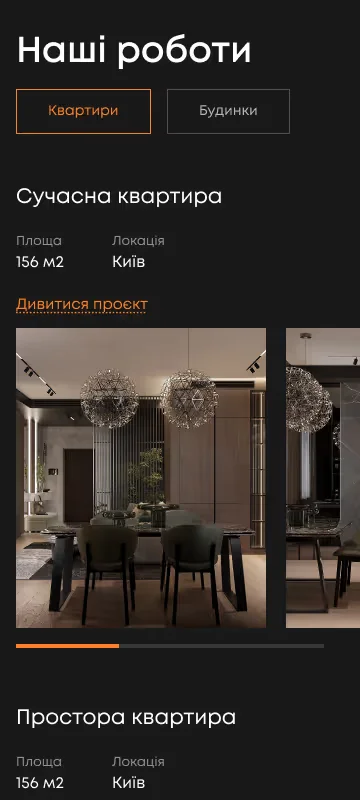
We engineered this exact high-detail mobile portfolio adaptation in the architectural and interior engineering platform GroupDesign. The four mobile screens below demonstrate how technical and commercial data is structured on smartphone viewports: the `Наші роботи` portfolio with `Квартири / Будинки` category tabs and project specs (`156 m²`, `Kyiv`), the `Вартість` pricing section detailing the `30% / 40% / 30%` milestone payment schedule alongside `Standart / Gold` tier tabs, the vertical `Формат роботи` workflow timeline (`01 Preparation -> 02 Layout Redesign -> 03 3D Visualization`), and the interactive `Результат до і після` Before/After sliders comparing CAD wireframe sketches against completed interiors:



2. Engineering Stack for Sub-Second Jobsite Loading
To guarantee 0.9-second page loads over weak jobsite LTE connections, we replace bloated WordPress themes with modern frontend engineering:
Automated Multi-Resolution WebP / AVIF Pipelines: Every 15MB drone photo is automatically converted into 5 responsive `srcset` breakpoints compressed to 85–140 KB without losing structural sharpness.
Tiled Deep-Zoom Masterplans: High-resolution site masterplans and CAD layouts load via progressive map tiles rather than crashing mobile Safari memory.
Global Edge CDN Caching: Static project passports and Pre-Q PDF archives serve from the nearest Cloudflare edge node in milliseconds. You can benchmark your current website's speed and trust signals against your top 3 regional rivals right now using our interactive B2B Competitor Scanner.
Key Takeaways
Ready to turn your construction or engineering website into a tender-winning asset?
In $500k–$5M+ commercial construction tenders, your website is audited by procurement and compliance officers: missing CC2/CC3 permits, ISO certificates, or fleet specs eliminates up to 70% of bidders during Pre-Q screening.
Every portfolio entry should be structured as an engineering passport detailing square footage, steel/concrete tonnage, execution timeline, EPC role, and BIM-to-reality comparisons.
Replacing generic contact forms with a 3-step ROM Cost Configurator and a '1-Click Pre-Q Dossier Download' boosts qualified tender inquiries (RFPs) 6x—from 0.35% to 2.1%.
Investing $6,500–$12,000 in a sub-second engineering B2B portal (0.9s LCP on 4G tablets) pays for itself from just 14% of the net margin on a single won construction contract.