Corporate B2B Websites
Corporate Website for EU & US Market Expansion: Trust Architecture, Compliance & Red Flags for Western Buyers
Why 80% of Eastern European manufacturers lose Western enterprise contracts before the first discovery call
When an industrial manufacturer, agricultural exporter, or engineering firm expands into the DACH region (Germany, Austria, Switzerland), France, the UK, or the United States, deals rarely collapse because of physical product quality. The fatal drop-off happens much earlier—at the exact moment a procurement officer or compliance auditor in Munich or Chicago opens your corporate website after a trade show meeting or a LinkedIn outreach message. Executing effective b2b website design for us market expansion and European trade requires understanding a core shift: Western buyers do not treat your website as a marketing brochure; they treat it as a primary Vendor Risk Assessment portal.
According to global B2B procurement benchmarks by Gartner and Bain & Company, an average buying committee of 6 to 8 stakeholders audits a supplier's digital footprint before ever replying to an outreach email, and 49% of corporate buyers plan to drop suppliers that fail to demonstrate transparent ESG and compliance credentials. When your domain lacks a legally updated German Impressum (§ 5 DDG), fires tracking pixels without GDPR Consent Mode v2, hides technical specs inside scanned Cyrillic PDFs, or relies on awkward machine translation, a $150,000–$500,000 contract silently evaporates. In this engineering guide, we break down export business website requirements, detail european b2b website compliance gdpr, and demonstrate through our delivered projects in Germany and France how a compliant B2B portal pays for itself with a single shipment.
The 30-Second Vetting Filter: What European & US Procurement Officers Look For on an Unfamiliar Supplier's Site
In local emerging markets, executives often treat a website as a secondary business card, assuming sales reps will handle all questions over the phone. In Western Europe and North America, that assumption is fatal. A Category Buyer will never schedule a call with an cross-border vendor unless the website passes an initial 30-second legitimacy audit. True building trust with foreign buyers b2b site architecture relies on verifiable engineering and legal artifacts that de-risk the transaction for the decision-maker.
1. Anatomy of the Western Buying Committee (6–8 Distinct Evaluators)
Enterprise export contracts are never signed by a single person. Your website is inspected sequentially by specialists with strict vetting criteria:
Procurement & Category Manager: looks for annual production capacity, Minimum Order Quantities (MOQ), Incoterms 2020 delivery capabilities, and supply chain redundancy.
Lead QA & R&D Engineer: inspects tolerance tables, chemical or material grades, CAD/BIM files, and downloadable laboratory test reports.
Legal & Compliance Counsel: scrolls straight to the footer to verify commercial register numbers, VAT/EORI identifiers, GDPR data handling, and sanctions compliance.
Chief Financial Officer (CFO): evaluates operating history, physical plant assets, and the presence of an EU/US trading entity or SEPA/ACH settlement accounts.
2. The 5 Instant Red Flags That Make Western Buyers Close the Tab
When auditing exporters inside our Corporate B2B & Export Websites practice, we consistently find five critical mistakes that trigger immediate vendor disqualification:
Free webmail addresses (`export.dept@gmail.com`) or the absence of a direct landline and regional EU/US phone number.
Generic Shutterstock photos of smiling models in hardhats instead of authentic high-resolution photography of your CNC machinery, quality labs, warehouses, and loading docks.
Unverifiable certification claims: displaying low-res ISO 9001, CE, or FDA logos without downloadable PDF certificates and active registry numbers verifiable via TÜV Rheinland, SGS, or UL.
Faceless 'About Us' pages: Western B2B commerce is built on executive accountability. Omitting real photos and LinkedIn profiles of your CEO, Head of Export, and Chief Engineer signals a shell company.
Sluggish mobile performance at trade shows: at events like Hannover Messe, Agritechnica, or Bauma, buyers scan your booth QR code on their smartphones. If your site weighs 18 MB and takes 9 seconds to load on congested expo Wi-Fi, the lead is lost forever.
3. Comparison Table: Domestic Brochure Site vs. EU/US Export-Grade B2B Portal
Below is the architectural difference between a standard domestic website and an export-ready digital trust center.
| Evaluation Criterion | Standard Domestic Website | EU / UK / US Export-Grade B2B Portal |
|---|---|---|
| Above-the-Fold Hero | Vague slogans ("Dynamic company with years of experience") & stock video | Exact industrial niche (NACE/SIC), annual capacity figures, plant locations & direct Request RFQ / Spec Sheet CTA |
| Footer Legal Transparency | Copyright year and a generic Privacy Policy link | Full § 5 DDG Impressum, physical plant address, Handelsregister/company ID, VAT/EORI, and D-U-N-S number |
| Quality Certifications | Small unclickable badge icons or expired scans | Verified Trust Center: downloadable PDFs for ISO 9001 / 14001 / CE / REACH / FDA with audit registry numbers |
| Technical Documentation | "Price on request" with zero dimensional or packaging data | Parametric spec tables, HS/TARIC customs codes, pallet weights, CAD/BIM files & SDS safety sheets |
| Privacy & Cookie Tracking | Missing banner or non-compliant "We use cookies -> OK" bar | Certified CMP banner (Google Consent Mode v2 + TDDDG) with equal-prominence Accept and Reject buttons on Layer 1 |
| Performance & Hosting | Single origin server, bloated scripts, mobile LCP > 4.0s | Global Edge CDN (Frankfurt, London, Virginia), WebP assets, Core Web Vitals score 95+ / 100 (LCP < 1.1s) |
Legal & Regulatory Foundation: German Impressum (§ 5 DDG), GDPR Consent Mode v2 & ESG Reporting
For companies entering the European Union or the United States, website compliance is a direct financial shield against regulatory fines, cease-and-desist letters, and suspended ad accounts. Engineering full european b2b website compliance gdpr into your site architecture from day one costs a fraction of defending a single cross-border legal claim.
1. The German Impressum Mandate: Transitioning from TMG to § 5 DDG
If you target buyers in Germany, Austria, or Switzerland, the very first link local legal counsel or competitors click is your Impressum (statutory legal notice). In May 2024, Germany officially repealed the old Telemedia Act (§ 5 TMG) and replaced it with the Digitale-Dienste-Gesetz (§ 5 DDG). Websites that still cite dead statutes like `§ 5 TMG` or lack a 1-click Impressum link from every page are prime targets for Abmahnungen—formal cease-and-desist warning letters issued by competitors or trade associations carrying immediate legal penalties of €1,500 to €5,000+ per infraction.
Every DACH-facing site we engineer includes a compliant Impressum containing:
Full legal entity name and corporate form (e.g., GmbH, Sp. z o.o., LLC, or registered EU trading subsidiary).
Complete physical street address of headquarters and manufacturing facilities (P.O. boxes are strictly prohibited).
Direct electronic and voice contact channels (dedicated corporate email + telephone number).
Authorized managing directors (Vertretungsberechtigte Geschäftsführer), commercial register court (Handelsregister / Amtsgericht), registration number, and VAT ID (USt-IdNr.).
2. GDPR, Germany's TDDDG & Mandatory Google Consent Mode v2
A dangerous misconception among industrial exporters is that "GDPR only applies to B2C retail." Under European Data Protection Board guidelines and Germany's TDDDG (§ 25), corporate IP addresses, work emails (`j.smith@enterprise.de`), and browser device identifiers qualify as personal data. Furthermore, Google Consent Mode v2 is strictly required for any site running Google Analytics 4, Google Ads, or LinkedIn Insight Tags across the EEA and UK.
We implement a strict 3-layer technical privacy architecture:
Equal visual prominence on Layer 1: German courts mandate that the "Reject Non-Essential" button must sit on the exact same first layer, with the same font size and visual weight, as the "Accept All" button.
Default Denied Signals: before an EU visitor actively opts in, all tracking scripts remain blocked at the network level, passing `ad_storage: 'denied'`, `analytics_storage: 'denied'`, `ad_user_data: 'denied'`, and `ad_personalization: 'denied'`.
Verifiable Double Opt-In (DOI): every RFQ form, spec-sheet download gate, and B2B newsletter signup logs timestamped consent with an unchecked-by-default privacy checkbox.
3. EU CSRD Sustainability (ESG) Portals & US ADA / WCAG 2.1 AA Accessibility
Under the EU's Corporate Sustainability Reporting Directive (CSRD) and Corporate Sustainability Due Diligence Directive (CSDDD), European enterprises are legally required to audit carbon footprints (Scope 3 emissions) and labor standards across their entire supplier base. Research shows 67% to 78% of B2B buyers weigh ESG posture during vendor selection. To pass this filter, we build a dedicated Sustainability & ESG Compliance section highlighting renewable energy usage, waste recycling, ISO 14001 (environmental management), and ISO 45001 (occupational health and safety).
For b2b website design for us market expansion, beyond displaying FDA, FCC, or UL/ETL certifications and your D-U-N-S Number, your site must comply with ADA Title III (WCAG 2.1 Level AA) digital accessibility standards. US law firms file thousands of lawsuits annually against B2B websites that lack keyboard tab navigation, screen-reader ARIA labels, or a minimum `4.5:1` text contrast ratio—all of which we bake directly into our frontend code.
Professional Localization: Why Machine Translation Destroys Industrial Credibility
Even a world-class factory with robotic production lines looks like an amateur operation if its website relies on automated Google Translate plugins or unedited AI translations. True cross border b2b website localization means adapting engineering terminology, measurement units, and regulatory nomenclature to match how native buyers search and specify products.
1. Industry Nomenclature, Imperial vs. Metric Units & Technical Hreflang SEO
Translating words is not enough; you must localize the engineering context:
United States (`en-US`): American engineers, general contractors, and buyers specify products in Imperial units (inches `in`, feet `ft`, pounds `lbs`, wire/sheet `Gauge`, PSI) and reference ASTM, ASME, ANSI, or UL standards. If your catalog only lists millimeters and domestic GOST/DSTU standards without ASTM equivalents, US buyers will bounce immediately.
European Union (`en-GB / de-DE / fr-FR`): requires strict adherence to EN / DIN / ISO norms, CE marking declarations, REACH / RoHS chemical compliance, and understated, fact-driven copywriting.
Multilingual Technical SEO: each language version must live on dedicated URL routes (`/en/`, `/de/`, `/fr/`) with bidirectional `hreflang` tags, localized meta descriptions, and region-specific Schema.org `Organization` and `Product` markup.
2. Re-Engineering European Editorial Trust: The ModeEstah Paris Case Study
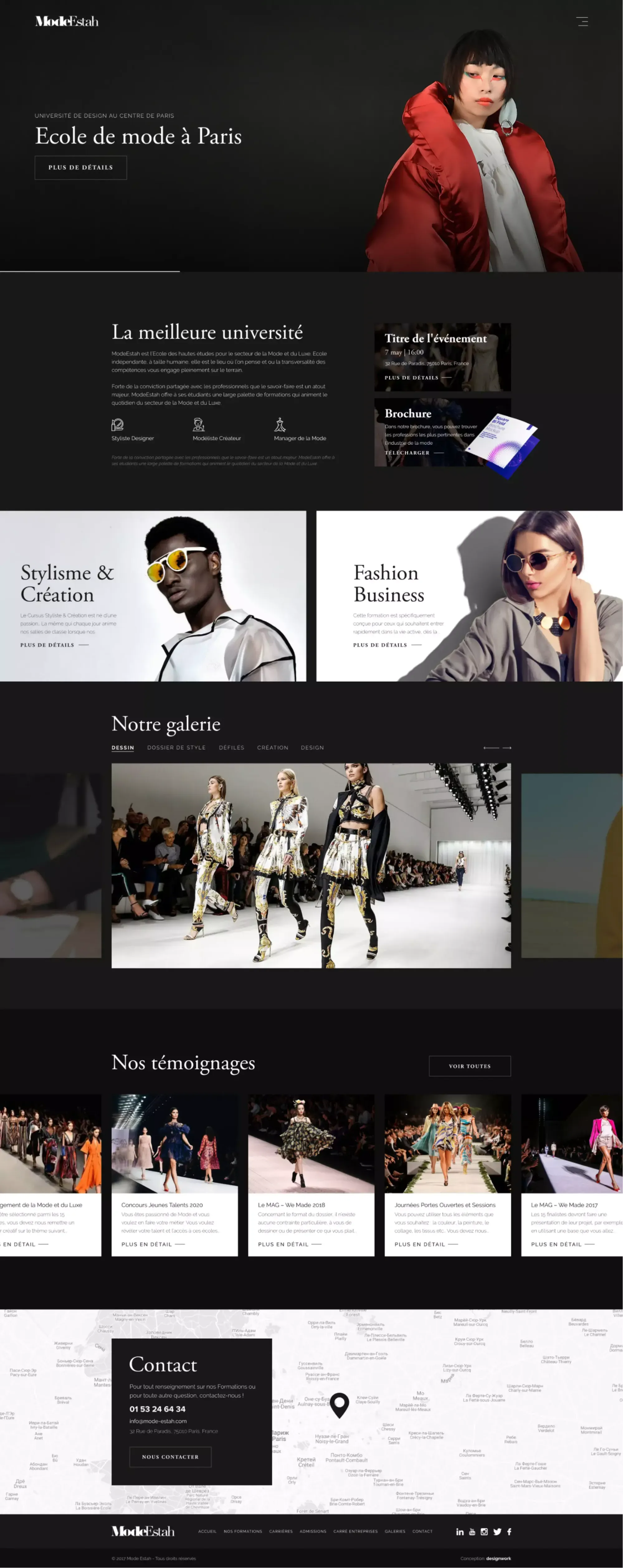
Winning trust in Western Europe demands native typographic precision, cultural fluency, and crystal-clear accreditation architecture. A strong example is our complete corporate website redesign for ModeEstah, a private fashion and design university in central Paris.
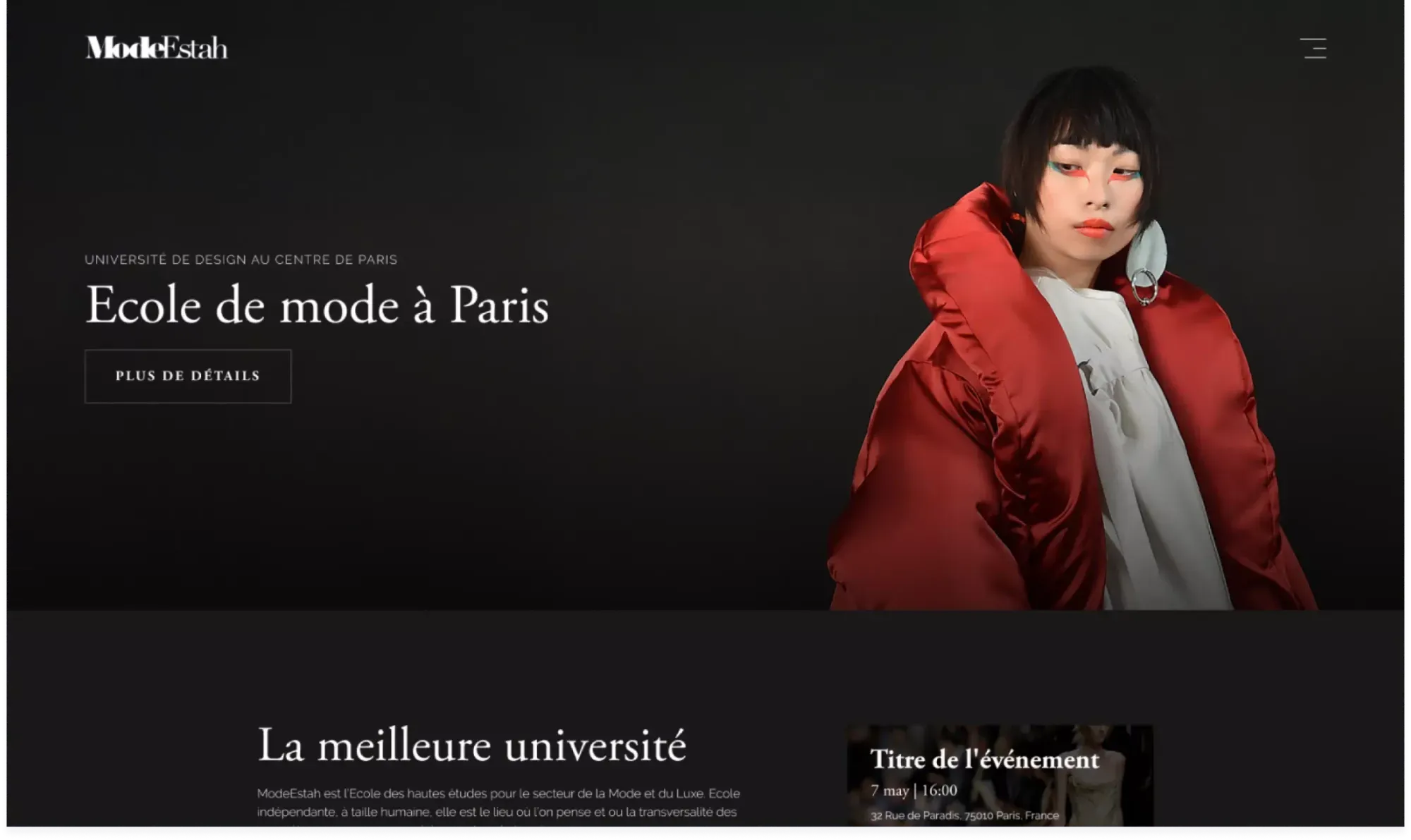
The institution's legacy website suffered from fragmented navigation and dated layouts that failed to communicate its Parisian academic prestige or clarify admission requirements for international applicants. We re-architected the entire platform in French: crafting an editorial dark hero viewport (`UNIVERSITE DE DESIGN AU CENTRE DE PARIS — Ecole de mode à Paris`), immediately highlighting the three career tracks (`Styliste Designer`, `Modéliste Créateur`, `Manager de la Mode`), open-house campus events (`32 Rue de Paradis, 75010 Paris, France`), and direct brochure download (`Brochure — TÉLÉCHARGER`), while inner course and Conditions d'admission pages spotlight the 96% graduate employment rate and sticky interview booking forms:
Presenting Logistics & Supply Chain Security: Incoterms, Bonded Warehouses & Lead Times to Hamburg, Rotterdam, or Chicago
The single biggest objection Western procurement teams raise when evaluating an Eastern European manufacturer is Supply Chain & Delivery Risk. If your website says nothing more than "We ship worldwide," a buyer in Rotterdam, Hamburg, or Chicago assumes customs delays and unpredictable freight costs. Your website must proactively eliminate logistics anxiety using hard supply-chain data.
1. Essential Modules of an Export Logistics & Fulfillment Page
We replace vague shipping statements with an engineered Logistics & Export Capabilities hub that answers every question a customs broker or import manager has:
Supported Incoterms 2020: explicit breakdown of fulfillment terms—whether you ship FCA (factory loading dock), DAP / DDP (door-to-door delivery to the client's EU warehouse with customs clearance handled by your EU trading entity), or FOB / CIF for ocean freight into US ports (Newark, Savannah, Houston) with rail forwarding to Chicago.
Transit Corridor Map & EU Buffer Warehouses: visual transit timelines (Warsaw / Gdansk: 48–72 hrs; Berlin / Hamburg: 4–5 days; Rotterdam / Antwerp: 5–6 days) plus disclosure of bonded or consignment safety-stock warehouses inside Poland, Germany, or Romania.
Packaging & Customs Documentation: palletization specs (EPAL Euro pallets, ISPM 15 heat-treated wood certification), truckload/container volume calculators, HS / TARIC customs tariff codes, and EUR.1 movement certificates allowing 0% EU import duty.
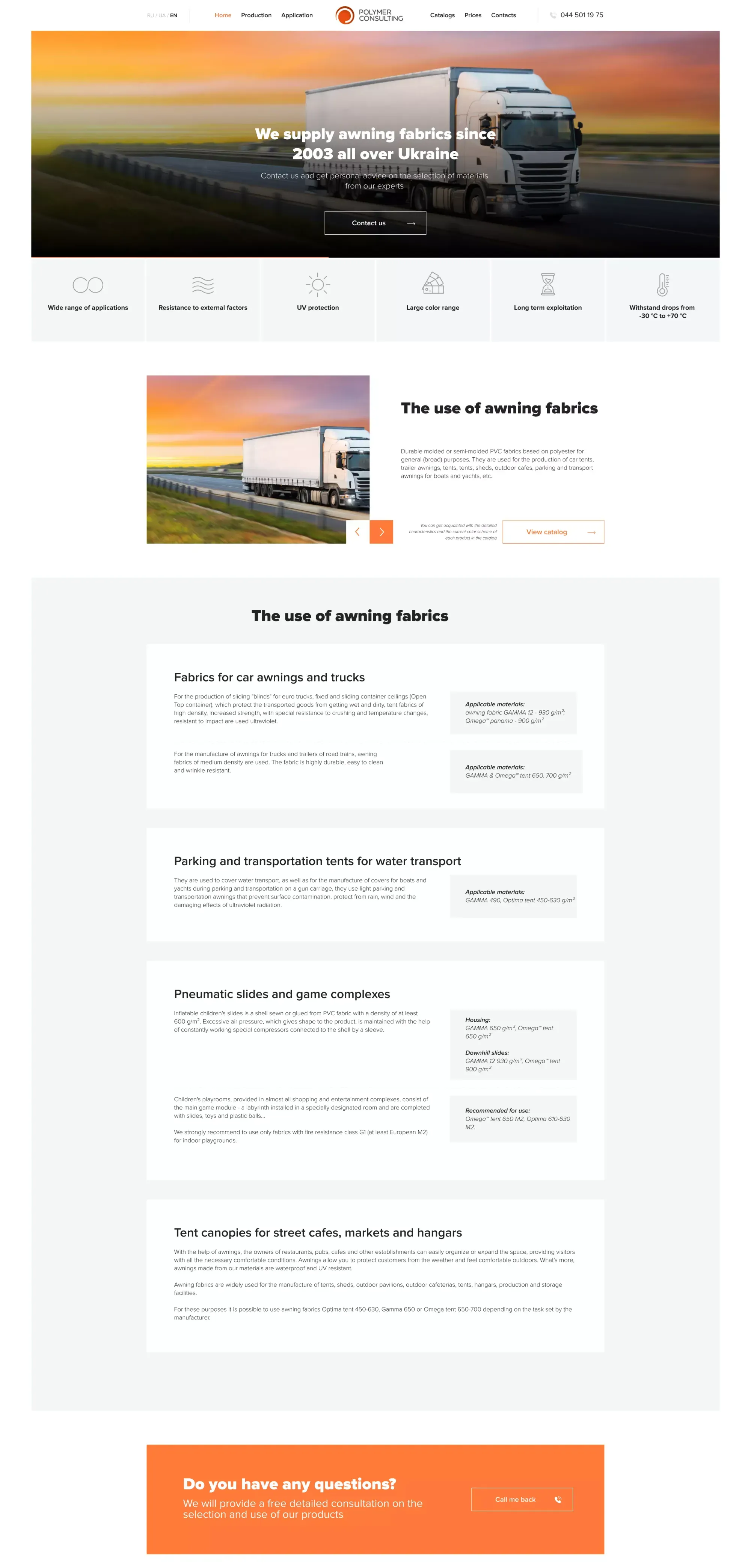
2. Structuring Industrial Material Specifications & Regional Hubs: The Polymer Consulting Case Study
In B2B manufacturing and distribution, logistics readiness goes hand in hand with accessible technical specifications—material density, roll dimensions, temperature ratings, and downloadable datasheets.
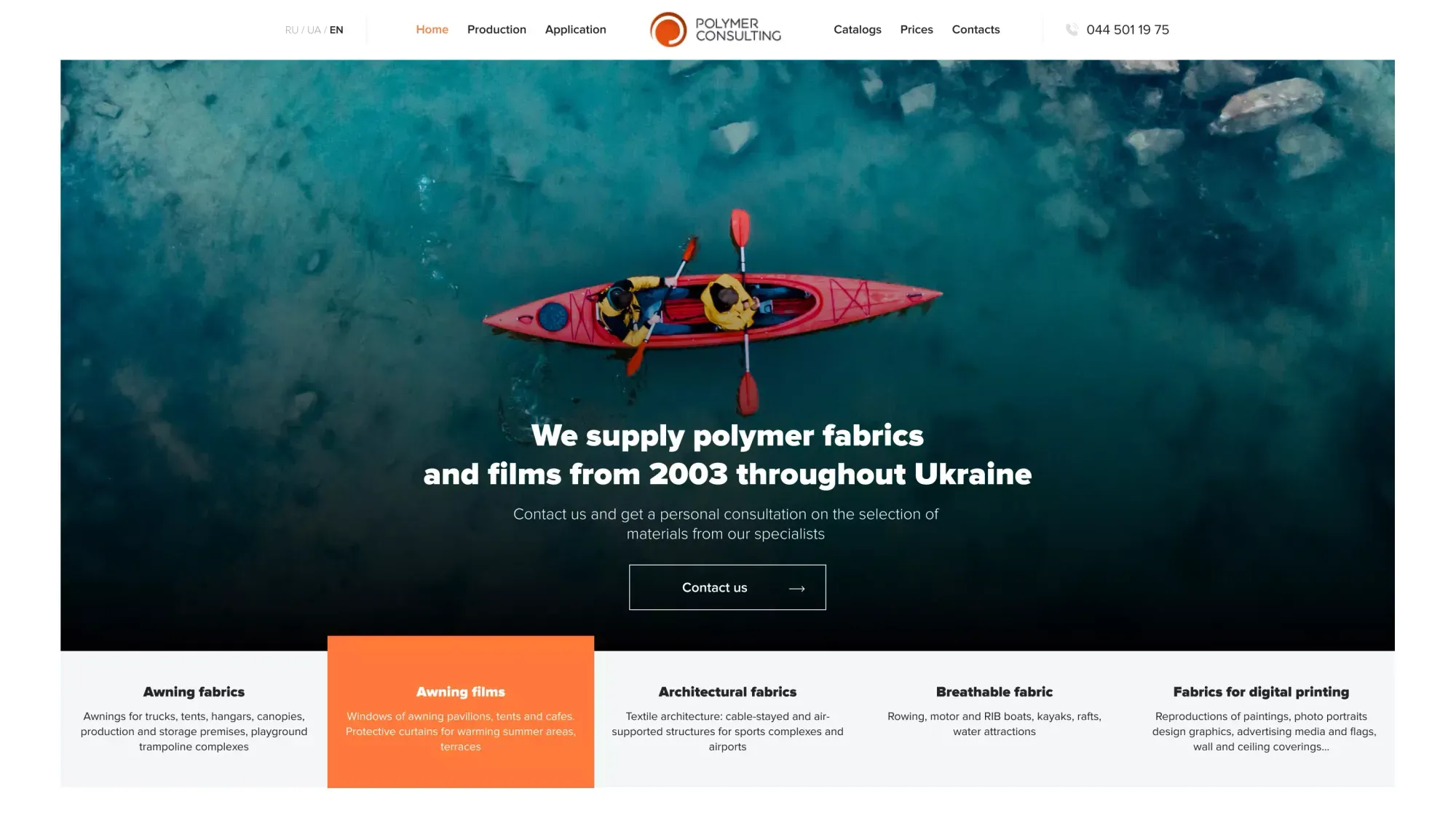
We engineered this exact B2B catalog architecture for Polymer Consulting, a major supplier of industrial polymer fabrics, architectural membranes, and PVC films. Instead of burying specifications inside unsearchable price lists, we structured the corporate catalog by industrial application: in the top viewport of the product direction page (`Брезент, ПВХ, Оксфорд`), procurement engineers immediately see 6 structured material property cards (Strength, Durability, Waterproofing, Elasticity, -30 °C to +70 °C Thermal Resistance, and UV Protection), followed by recommended fabric grades and density in g/m² for hangars and truck awnings, downloadable PDF catalog libraries, and an interactive regional warehouse map:
German & International B2B Case Studies: Inside the IBR Engineering Firm Project & Export ROI Math
The most reliable proof of our cross-border engineering standards is building turnkey corporate platforms directly for German enterprises. Below, we examine the unit economics of an export-grade website and break down our turnkey build for German engineering firm IBR.
Auto-Translated Domestic Site vs. EU/US Compliant Export B2B Portal: 12-Month Pipeline Comparison
- Procurement Vetting Survival Rate: 82% of Western buyers bounce within 30 seconds
- Trade Show & LinkedIn Traffic-to-RFQ Conversion: 0.25% (22 low-intent inquiries per year)
- Cost Per Qualified B2B Inquiry (CPL): $1,636
- Closed Export Contracts Per Year: 1 contract (others blocked by legal/QA vetting)
- Net Annual Profit (Margin minus Marketing Spend): −$9,600 ($26,400 margin − $36,000 marketing & expo spend)
- Procurement Vetting Survival Rate: 100% compliant with § 5 DDG, GDPR Consent Mode v2 & ISO/CE
- Traffic-to-Qualified RFQ Conversion: 1.6% (144 spec-ready tender inquiries per year)
- Cost Per Qualified B2B Inquiry (CPL): $250 (6.5x reduction in acquisition cost)
- Closed Export Contracts Per Year: 6 long-term supply contracts ($720,000 export revenue)
- Net Year-1 Profit (after marketing & $9,500 site build): +$112,900 ($158,400 margin − $36,000 marketing − $9,500 build)
Exhibiting at a single 4-day German trade show (booth rental, sample freight, flights, and hotels) costs $12,000–$25,000. A turnkey export-grade B2B website costs $6,000–$12,000 once, operates 24/7, and prevents you from losing 80% of the buyers who scan your QR code at that trade show.
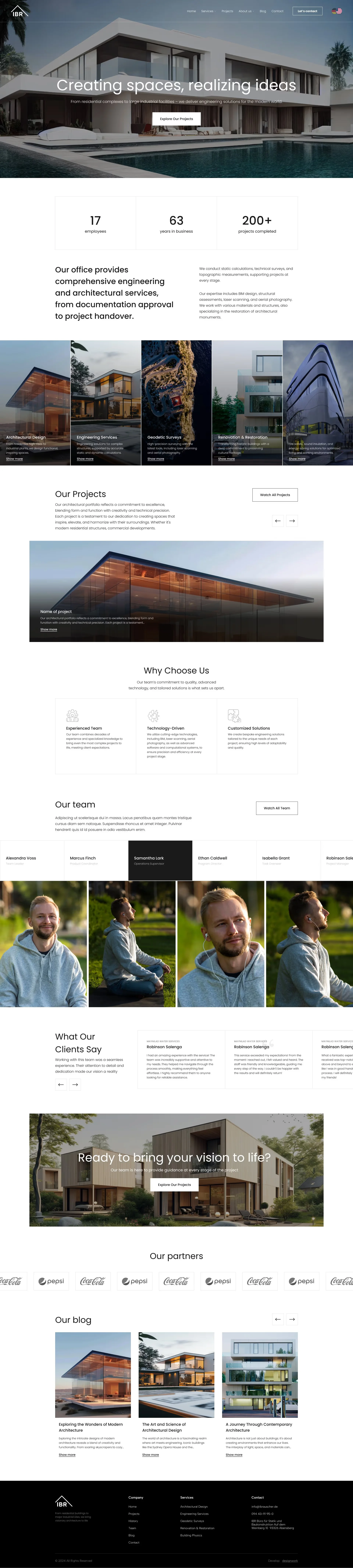
1. The IBR Case Study (Abensberg, Germany): Digitizing 63 Years of Engineering Heritage & 200+ Projects
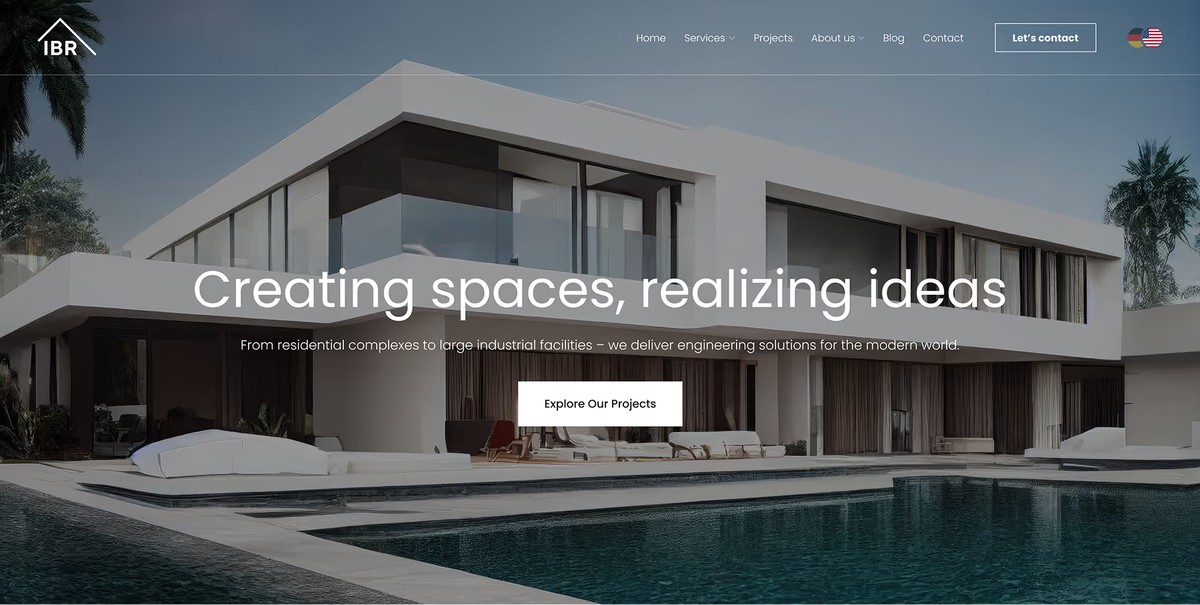
When German engineering and architectural firm IBR (based in Abensberg, Bavaria) commissioned us to design and build their turnkey corporate website on Webflow, the core challenge was uniting their institutional heritage (founded in 1961) with their modern capabilities in BIM modeling, structural engineering, and surveying.
We engineered a rigorous German B2B trust funnel:
Hard Authority Metrics Above the Fold: visitors immediately see verifiable firm credentials (63 years in business, 17 in-house engineers, 200+ completed industrial and municipal projects) alongside 5 clearly structured engineering verticals.
Standardized Tender Case Study CMS Template: for their 200+ project portfolio, we built a structured case study layout featuring a top specification bar with hard facts required by procurement boards—completion year, client name, construction budget, location, engineering challenge, and delivered scope.
1961–2024 Heritage Timeline & Dual Theme: a dedicated vertical timeline pairs archival German industrial construction photography with company milestones, while a dual dark/light mode lets engineers switch between high-contrast 3D architectural renders and clean light-mode technical reading:
2. 6-Week Roadmap to Launch Your EU/US Export Website
To transform a domestic site into a compliant cross-border B2B platform without a drawn-out 12-month agency cycle, we execute a focused 6-week engineering sprint:
Competitor & Compliance Audit (Week 1): benchmark your current domain against 3–5 German or US competitors using our B2B Competitor & Trust Scanner to identify speed, certification, and UX gaps.
Buying-Committee UX Architecture & Localization (Weeks 2–3): structure the sitemap around procurement, QA engineer, and legal personas; adapt terminology (ASTM/EN, Imperial/Metric, HS codes, Incoterms 2020); and build interactive Figma wireframes.
High-Trust UI System & Spec Digitization (Weeks 4–5): design responsive layouts meeting WCAG 2.1 AA contrast rules, replace scanned PDFs with interactive specification tables, and structure your ISO/CE/ESG Trust Center.
Clean Frontend Build, Consent Mode v2 & Launch (Week 6): ship production code scoring 95+ on Google PageSpeed, configure certified GDPR/TDDDG Consent Mode v2 banners, publish a compliant § 5 DDG Impressum, and connect RFQ forms directly to your CRM.
Key Takeaways
Ready to scale exports to the EU or US without losing buyers to trust and compliance red flags?
Western B2B buying committees (6–8 stakeholders) vet unfamiliar suppliers in 30 seconds: missing plant photography, unverifiable ISO/CE/FDA certificates, or vague specs eliminate 80% of exporters before the first email.
Targeting Germany (DACH) and the EU legally requires an updated § 5 DDG Impressum (replacing the repealed TMG), a TDDDG / Google Consent Mode v2 banner with a Layer-1 Reject button, and an ESG / CSRD sustainability section.
Machine translation destroys industrial credibility: cross-border B2B sites require native engineering nomenclature (NACE, HS codes, ASTM vs. EN), dual Imperial/Metric specs for US vs. EU buyers, and clear Incoterms 2020 logistics maps.
Investing $6,000–$14,000 in an export-grade B2B website costs less than a single European trade show booth and achieves 100% payback from the very first signed supply contract.