Custom CRM & Automation
Automating B2B Wholesale & Distribution: Custom CRM for Multi-Tier Pricing, Inventory & Order Processing — Build Cost & 4.8-Month ROI
Why manual dealer order entry in spreadsheets and boxed CRMs bleeds up to 22% of wholesale net margin
A wholesale distributor managing 150–400 active dealers and a 3,000+ SKU catalog faces daily operational paralysis: regional partners submit restock orders via WhatsApp voice notes, photographed notepad pages, or messy Excel attachments, forcing inside sales reps to spend 14–22 minutes manually validating every single order. For each transaction, an operator must cross-reference base price lists, partner-specific discount tiers, quarterly volume rebates, pallet case-pack multiples, credit limits, and live batch availability across multiple warehouses. According to APQC (American Productivity & Quality Center) and Gartner benchmarks, the average labor cost of manually processing a single B2B order ranges from $14.40 to $38.00, while 18–30% of manually keyed order cycles contain pricing, SKU, or stock allocation errors.
When distribution executives attempt to fix this bottleneck with standard cloud CRMs (HubSpot, Zoho, Pipedrive, or Salesforce Sales Cloud), they hit an architectural wall: off-the-shelf CRMs are built for linear service pipelines, not multi-dimensional inventory matrices. Conversely, legacy enterprise ERPs like Oracle NetSuite ($129–$199/user/month plus a $1,500–$2,500/month base fee and $60,000+ partner implementation) lock businesses into perpetual six-figure subscription rent. In this engineering guide, we break down how to architect a bespoke wholesale b2b crm software platform and self-service dealer portal ($8,000–$20,000 turnkey) that eliminates fulfillment errors and compresses order-to-dispatch time from 24 hours to 40 minutes.
Wholesale Pricing Hell: Why Boxed CRMs Break on Multi-Tier Dealer Discounts
In retail e-commerce, a product price is a single static cell in a database. In wholesale distribution and manufacturing, the final unit price on an invoice is the output of a real-time formula governed by 6 to 8 variables. Generic off-the-shelf software collapses the moment a dealer submits an 85-line order requiring simultaneous cross-category pricing rules.
1. The 4-Dimensional Pricing Matrix & Promotion Conflict Prevention
Real-world distributor unit economics never rely on a flat "10% off everything" coupon. When we engineer a multi tier pricing crm, the calculation engine resolves four concurrent layers:
Partner Tier & Brand Matrix: A Gold-tier dealer might receive a 22% discount on proprietary private-label items, 12% on imported Class-A components, and strictly 4% on low-margin regulated SKUs.
Volume Breakpoints & Case-Pack Multiples (MOQ): Unit pricing shifts dynamically depending on whether the buyer orders 1 master carton (12 units), a half-pallet (144 units), or a full truckload—while strictly enforcing packaging multiples so nobody can order "17 units" of a 12-pack item.
Currency Indexing & Payment Terms: Real-time recalculation based on whether the dealer pays 100% upfront via ACH/wire, uses Net-15 credit terms, or draws against a consignment credit line.
Automated Margin Floor Guardrails: If an overlapping seasonal promo and a dealer's contract discount push net margin below your threshold (e.g., 8%), the system flags the line item in red and requires commercial director approval before locking the invoice.
We engineered this exact matrix pricing architecture inside the SIESTA management platform. On the top screen of the "Pricing" (`Ціноутворення`) module, managers operate a visual multi-category rate grid across dates paired with a slide-over bulk pricing configurator for setting base rates and percentage markups, while the "Conditions" (`Умови`) tab manages automated client-tier discounts (`Gold -20%`, `Silver -12%`, `Bronze -4%`) with built-in duplicate promotion alerts:

2. Architectural Comparison: Spreadsheets vs. Enterprise ERP vs. Custom B2B CRM
To illustrate why a tailored custom order management system for distributors outperforms rented enterprise clouds over a 36-month horizon, here is the verified Total Cost of Ownership (TCO) breakdown for a distributor with 30 internal staff and 200 external dealers. You can explore our full engineering stack in the Custom CRM & Financial Analytics hub.
| Cost Driver / Operational Metric | Option 1: Excel + Legacy Accounting + Messengers | Option 2: Cloud ERP/CRM (NetSuite / Odoo Custom, 30 Seats) | Option 3: Turnkey Custom B2B CRM + Dealer Portal |
|---|---|---|---|
| 3-Year Internal User Licenses (30 Staff) | $0 (or local legacy accounting licenses) | $66,000–$140,000+ ($61–$155/seat + base platform fee) | $0 (zero per-seat license tax) |
| External Access for 200 B2B Dealers | None (dealers email/message files to reps) | Often billed extra as Portal Seats or API tier upgrades | $0 (unlimited B2B dealer accounts included) |
| Implementation & Engineering Cost | Built ad-hoc ($0 upfront) | $25,000–$75,000 (integrator fees, 6–12 mo rollout) | $11,000–$18,500 (one-time CapEx, 6-week MVP) |
| Processing Time per Wholesale Order | 18–25 minutes (manual price & stock checks) | 6–9 minutes (bloated UI tabs & slow page loads) | 40–90 seconds (dealer self-service or hotkey grid) |
| Fulfillment & Pricing Error Rate | 14%–22% (wrong SKU, wrong tier price, out-of-stock) | 3%–5% (webhook sync lag between cloud and warehouse) | < 0.4% (hard MOQ validation & live batch reservation) |
| Total 3-Year Cost of Ownership (TCO) | $82,000+ burned in payroll waste & return shipping | $95,000–$215,000+ in non-recoverable subscription rent | $12,800–$20,300 (including $50/mo dedicated cloud VPS) |
Fast Dealer Checkout: B2B Self-Service Portal Instead of Messenger Chaos
According to McKinsey's B2B Pulse research, over 70% of B2B buyers actively prefer digital self-service ordering over calling or messaging sales reps, and 67% are comfortable executing transactions exceeding $50,000 entirely online. Deploying a custom custom supply chain crm starts by removing sales reps from routine data entry and shifting 80% of repeat restock orders into a dedicated B2B dealer portal.
1. Contract-Locked Catalogs & 30-Second Consumable Reordering
When a regional dealer or installation contractor logs into their portal, the interface renders only their authorized product portfolio, exact contract unit prices, loyalty volume progression, and downloadable tax invoices. They never need to call a rep to check stock or negotiate their already-agreed discount.
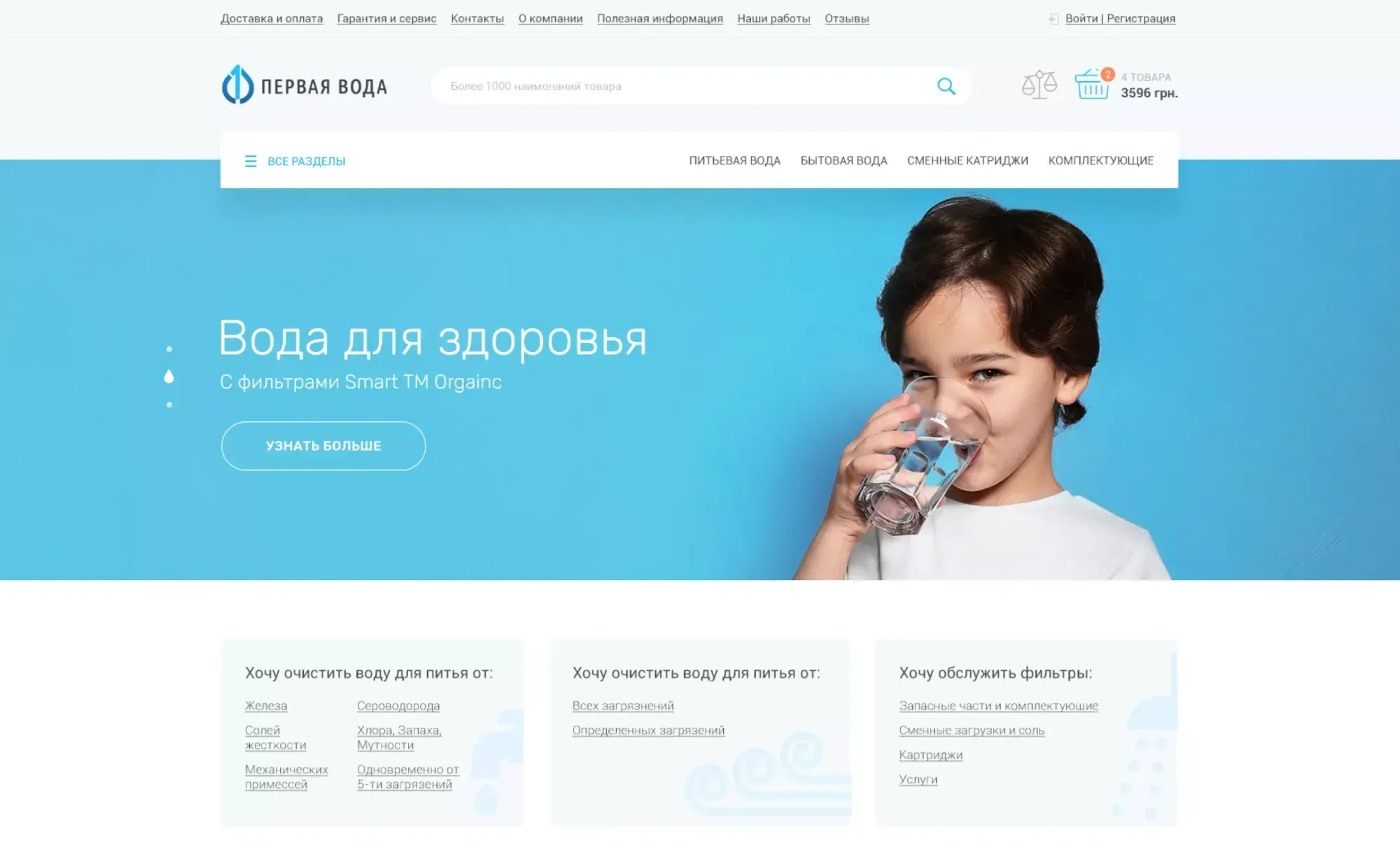
We implemented this exact repeat-buyer account architecture in our e-commerce and portal redesign for Persha Voda, a supplier of water filtration systems, pumps, and replacement media. On the primary account screen, buyers immediately see their active cumulative loyalty discount ("Your cumulative discount is 3%", calculated automatically from lifetime order volume), verified phone numbers, and saved branch delivery addresses, while the left-hand navigation provides one-click access to "Order History" and a dedicated "Consumables" section for rapid filter cartridge restocking:

2. Mobile B2B Ordering (375px): Restocking Directly from the Warehouse Aisles
In physical distribution, store managers, field engineers, and warehouse supervisors rarely sit at desktop monitors—they build restock orders on their smartphones while walking warehouse aisles. If your B2B portal forces mobile users to pinch-and-zoom across wide desktop spreadsheets, dealers will abandon it and go back to sending WhatsApp voice messages.
When designing the e-commerce and account ecosystem for Teren Blade, we built dedicated workflows for wholesale and repeat buyers: the desktop account portal includes wholesale buyer verification status and cumulative discount tier tracking, while the `375px` mobile interface is engineered for rapid one-handed ordering. The four screens below demonstrate the mobile navigation drawer with instant search and direct "Personal Account" (`Особистий кабінет`) entry, the mobile storefront, the product screen with a prominent SKU code (`АРТИКУЛ: 87589235`), and the technical specification grid (`CPM-Magnacut`, `59-60HRC`) featuring a quantity stepper (`- 2 +`), live warehouse stock indicator ("7 units left"), and a persistent `Thumb Zone` add-to-cart bar:


Real-Time Inventory Sync: Batch Reservations & Automated Invoice Calculation
Nothing damages B2B distributor trust faster than overselling: a dealer wires payment for 200 units, only to be told six hours later that the warehouse already shipped that batch to someone else. A production-grade b2b inventory tracking dashboard operates like a banking ledger—strictly separating physical on-hand stock, active TTL holds, and net available-to-promise (ATP) inventory.
1. Three-State Stock Ledger: Physical On-Hand, Soft TTL Hold & Available-to-Promise
In a custom B2B CRM, we eliminate hourly CSV/XML cron jobs because a 60-minute sync delay during peak morning trading creates dozens of stock collisions. Instead, we implement event-driven webhooks and transactional database locks:
Instant Soft Hold with TTL Timer: The second a dealer clicks "Generate Proforma Invoice" or an operator locks a quote, those exact batch units enter a 24-hour `Soft Hold`. Every other dealer logged into the portal immediately sees the updated net available count.
Automated Hold Expiration: If payment is not received before the TTL countdown expires (and no credit line override is active), the system automatically releases the stock back into general availability without manual intervention.
Multi-Warehouse Routing & Pallet Math: When a 50-line order spans two regional warehouses, the backend automatically splits the fulfillment pick-list by location, calculates gross pallet weight and cubic volume, and generates carrier shipping labels automatically.
2. Real-Time Two-Way POS & Inventory Synchronization: The Golden Dragon Case Study
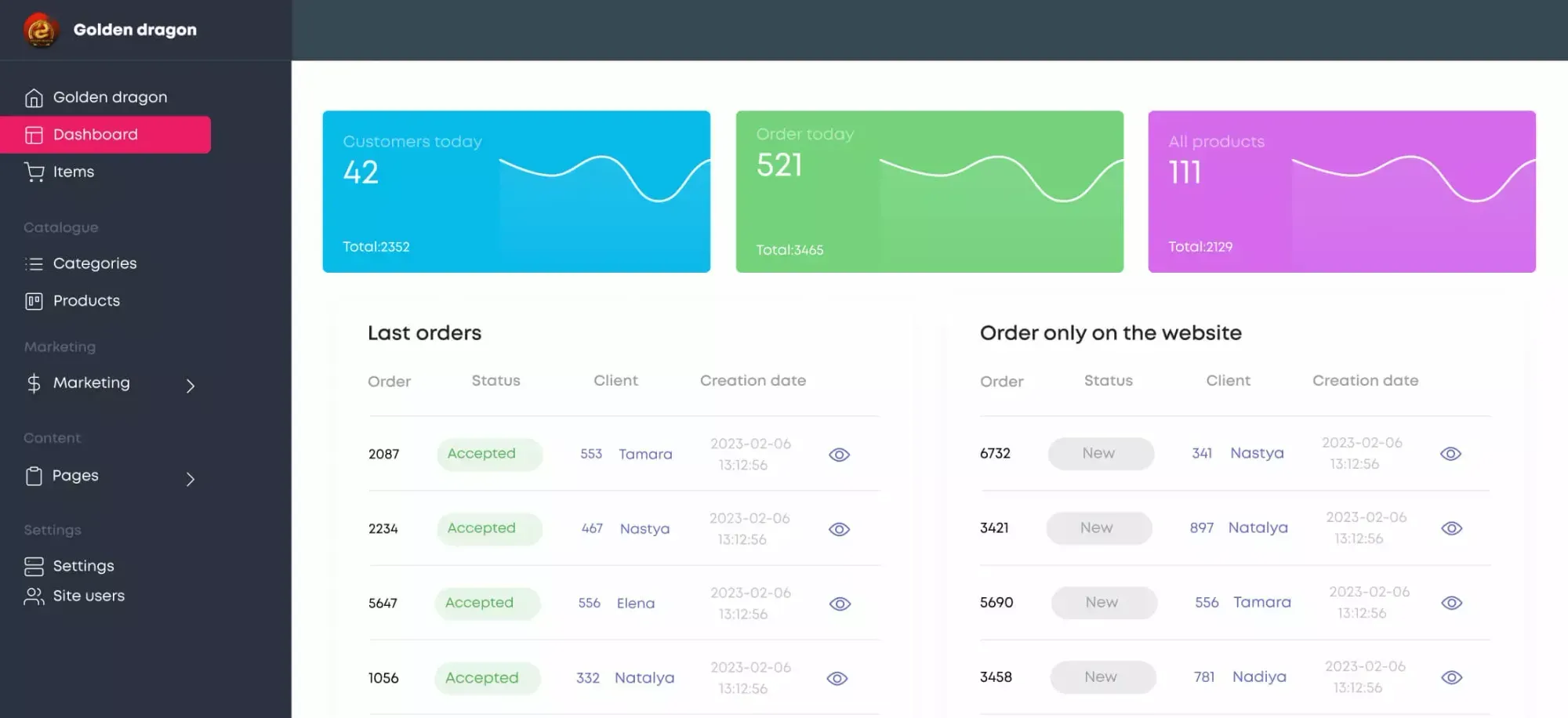
We built this exact real-time synchronization between customer ordering, a custom operator admin panel, and live inventory accounting for Golden Dragon. Facing high daily volumes of multi-item orders, the business needed to eliminate manual ticket re-keying and prevent out-of-stock items from being ordered. We designed and developed a bespoke CMS and order management dashboard synchronized two-way with Poster POS in real time, giving management live visibility into daily order flow and active catalog items while allowing operators to toggle categories and bundle promos in one click:
Keyboard-First Operator UI: How One Rep Processes 150 Complex Orders a Day
Even with a high-adoption B2B portal, roughly 25–30% of wholesale volume still requires inside sales assistance (custom engineering quotes, tender specifications, or split-delivery scheduling). Standard cloud CRMs cripple operator speed because they are designed around mouse clicks and modal pop-ups—forcing a rep to click 200+ times just to enter a 40-line order.
1. High-Density Data Grids, Sub-Second Search & Clipboard Matrix Paste
When architecting internal operator workspaces, we apply keyboard-first ergonomics modeled after financial trading terminals:
30ms In-Memory Search (`Cmd+K` / `F2`): Operators locate any SKU by the last 4 digits of a part number, barcode, OEM cross-reference, or alias in under 30 milliseconds.
Mouse-Free Tabular Entry (`Tab` → `Qty` → `Enter`): Reps type a SKU code, hit `Enter`, input case quantity, see live line-item margin, and press `Ctrl+S` to dispatch the pick-list directly to warehouse barcode scanners.
3-Second Excel Clipboard Parser: When an enterprise buyer emails a 120-line spreadsheet, the operator copies the `SKU` and `Quantity` columns and pastes them directly into the CRM smart parser. The engine maps every SKU, applies the buyer's contract price matrix, checks warehouse stock, and highlights only the 2–3 lines requiring an alternative substitute.
2. Automated Accounts Receivable Stoplight (Hard Credit Limit Gate)
To ensure rapid order processing never exposes the company to bad debt, every order screen features a live financial stoplight wired directly to your bank feeds:
Green State: Receivables are within the approved credit limit and zero invoices are past due—warehouse dispatch is approved automatically.
Amber State: Previous batch invoice is due within 48 hours—the CRM automatically dispatches an automated Telegram/Email payment link to the dealer's finance team.
Red State (Hard Stop): An invoice is 5+ days overdue or the new order exceeds the credit limit—the "Send to Warehouse" button is hardware-locked for sales reps until a bank webhook confirms wire receipt or the CFO issues a 1-click override token.
Implementation Economics: Slashing Fulfillment Cycles from 24 Hours to 40 Minutes
Replacing spreadsheet chaos with a proprietary B2B CRM and dealer portal is a high-yield capital investment with measurable unit economics. Below is the financial model for a mid-market distributor processing 1,800 wholesale orders per month.
Manual Excel + Legacy ERP Entry vs. Custom B2B CRM & Dealer Portal (1,800 Orders/Mo)
- Rep Time per Order Specification: 22 minutes (660 staff hours/mo spent typing)
- Processing Cost per B2B Order: $16.80 (payroll burn + invoice rework)
- Mispicks & Return Logistics Losses: $1,850/mo (wrong SKU or wrong discount tier)
- Lost Sales from Stale Stock Counts: $2,300/mo (canceled lines after payment)
- Order-to-Warehouse Dispatch Cycle: 18–24 hours (waiting in rep message queues)
- Dealer Self-Service Portal Share: 78% of orders placed directly by dealers in 2 mins
- Processing Cost per B2B Order: $1.90 (8.8x reduction in transaction cost)
- Pricing & MOQ Calculation Errors: $0 (contract matrices enforced automatically)
- Repeat Order Frequency Uplift (LTV): +19% from 24/7 live stock visibility & 1-click reorders
- Order-to-Warehouse Dispatch Cycle: 40 minutes (instant batch hold & carrier label sync)
Freeing 75% of your 14 operators' time allows your business to scale from 220 to 500+ active wholesale dealers without hiring additional back-office staff or paying $30,000+/yr in ERP seat licenses.
Phased 6–8 Week Rollout Protocol Without Halting Warehouse Shipments
We never flip a live distribution company onto new software overnight. Deployment follows three zero-downtime engineering phases:
Weeks 1–2 (Price Matrix Audit & Interactive Figma Prototype): We map your existing Excel formulas and ERP database schemas, formalize multi-tier discount rules, MOQ multiples, and credit limits, and deliver a clickable prototype of both the operator grid and dealer portal.
Weeks 3–5 (Pricing Engine & Two-Way Warehouse API Bridge): We build the PostgreSQL core, configure real-time stock holds and webhook sync, and integrate automated invoicing, bank feeds, and freight carrier APIs.
Weeks 6–7 (Pilot Launch with 15 Core Dealers): Internal operators run the system in parallel first, followed by onboarding 15 trusted dealers into the self-service portal. Once invoice accuracy is verified at 100%, you roll out access across your entire dealer network. To quantify your exact monthly savings in 2 minutes, run your team's numbers in our interactive Excel-to-CRM Waste & Payback Calculator.
Key Takeaways
Ready to move your wholesale dealers out of messenger chaos into a fast B2B self-service portal?
Manual B2B order entry from messengers and spreadsheets costs $14–$38 per order and introduces pricing or inventory errors into 18–30% of fulfillment cycles.
Boxed SaaS CRMs fail on 4-dimensional dealer discount matrices and pallet multiples, while enterprise ERPs (NetSuite, custom Odoo) drain $95,000–$200,000+ over 3 years in seat fees.
A custom B2B CRM with a self-service dealer portal shifts up to 78% of routine restock orders online 24/7 and compresses fulfillment time from 24 hours to 40 minutes.
A turnkey $11,000–$18,500 investment pays for itself in 4.8–7 months with $0 per-user or per-dealer subscription fees.